


Wooden Watch Winder

A wooden watch winder solves a specific problem: automatic watches stop when left still. A Wooden Watch Winder maintains gentle rotation so your movement stays lubricated, complications remain set, and each timepiece is ready to wear at a moment’s notice. Instead of resetting calendars or moon‑phases after downtime, controlled motion preserves accuracy and convenience.
This page focuses strictly on the winder function—how calibrated turns‑per‑day, directional cycles, and quiet motors protect mechanical health while displaying your watches in refined wood. Expect pragmatic guidance, measurable benefits, comparison tables, and maintenance tips tailored to winders. Explore below to choose settings, capacity, and finishes with confidence.
Unlike static storage, a wooden watch winder recreates wrist‑like motion to keep the mainspring tensioned. That motion keeps oils distributed, reduces stiction in the gear train, and prevents the time and date from drifting. The result is stable accuracy and less wear from repeated manual setting.
| Movement profile | Recommended TPD & Direction |
|---|---|
| Low‑inertia automatic (simple date) | 650–800 TPD, clockwise or bidirectional |
| Mid‑complexity (day/date, GMT) | 900–1200 TPD, bidirectional preferred |
| High complication (annual/perpetual, moon‑phase) | 1200–1600 TPD, consult spec; avoid continuous runs |
Because a winder is an active device, safety features matter. Look for motor‑stop safety that halts rotation when the door opens, and ensure holders accommodate up to 60 mm cases without strain. The wood enclosure adds mass that damps vibration, while the interior (velvet or similar) protects polished surfaces as rotation cycles.
Start 200 TPD below the published maximum for your movement. If the watch loses power, step up in 100‑TPD increments. This ensures sufficient winding with the least motion—kinder to both watch and motor.
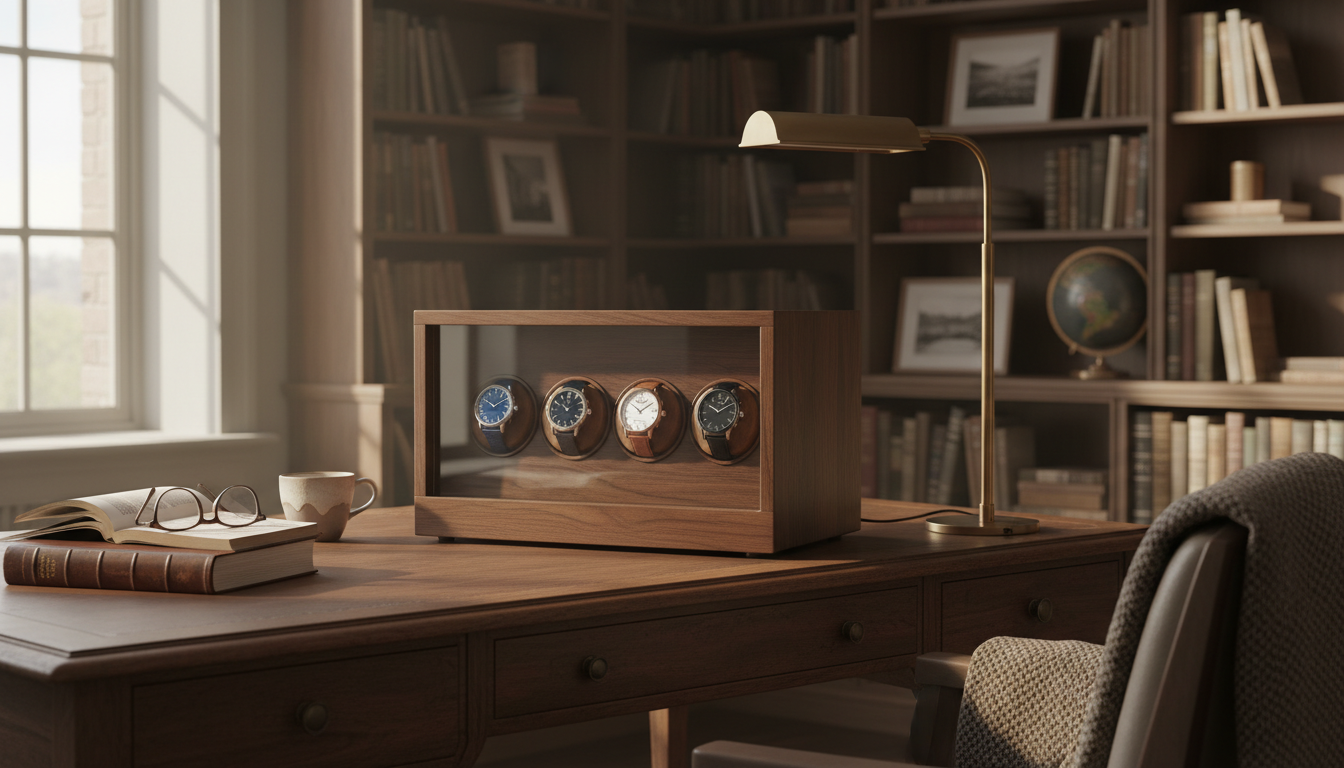
Capacity influences how independently you can set programs. A single bay is focused and compact; dual or quad winders offer per‑watch profiles, critical when different calibers require distinct TPD and direction. Choose by how many automatics you want kept running simultaneously—today and in the near future.
| Capacity | Best for |
|---|---|
| 1 watch | Daily driver on rotation, narrow TPD band, bedside use |
| 2 watches (independent) | Two different calibers, bidirectional vs single‑direction mixes |
| 4 watches | Complications plus divers, separate day/night schedules |
If you often wear two or three pieces in rotation, explore a dedicated three‑slot range to keep each movement on its own schedule. See the three‑watch references to compare independent rotors and footprint.
Avoid pairing two watches with different winding requirements on a single shared rotor. Mismatched TPD or direction means one will be over‑ or under‑wound.
Choosing a wooden watch winder is about control and protection. Prioritize these seven elements to keep lubrication distributed while avoiding side effects like magnetization or premature wear.
| Spec | Recommended value or feature |
|---|---|
| Noise level | below 10 dB at 1 m for bedroom placement |
| Interior lining | Velvet or microfiber to protect polished cases |
| Finish | Piano lacquer on solid or veneered wood grain |
| Door & lock | locking door, motor‑stop on open, glass for display |
Expanding a collection? Evaluate multi‑bay cabinets with independent controls, scheduled rest windows, and soft‑start motors to reduce torque shock on heavier pieces. For significant capacity, compare large‑capacity winders that keep many automatics synchronized without constant manual intervention.
Bidirectional programs can reduce required TPD by ~20% versus single‑direction modes, since many calibers wind in both directions. Less motion, same power reserve.

Nightstand placement demands silence. Look for precision geartrains, rubber isolation mounts, and soft‑start ramps. A good wooden enclosure absorbs resonance, and intelligent cycles pause rotations for long rest intervals—keeping the mainspring topped while your room stays quiet.
| Noise control feature | User benefit |
|---|---|
| Soft‑start rotation | Lower startup click; gentler on heavy watches |
| Isolation mounts | Less resonance through wood furniture |
| Night schedule | No movement during sleep; resumes at set time |
Prefer to fine‑tune motion profiles further? Browse the full automatic range to weigh additional programming flexibility, lock types, and display options—all within wood‑finished cabinets built for discreet operation.

Selecting the right unit means matching motion parameters and cabinet details to your watches and room.
| Profile | Recommended winder traits |
|---|---|
| Daily wearer + 1 dress watch | Single bay, bidirectional, 650–900 TPD, low noise |
| Two automatics in rotation | Dual independent rotors, separate TPD/direction, lock |
| Complications + weekend pieces | Quad with calendar‑friendly scheduling, LED display |
For collections that cycle between office and weekend pieces, a six‑place cabinet with independent programming keeps every movement on schedule. See this six‑watch walnut cabinet for an example of balanced capacity and control.
If you only need to maintain a single daily driver, a compact unit with quiet operation and a simple interface is often the most convenient choice. Consider a compact single unit with stable pillow grip and bidirectional cycles.
It’s a motorized cabinet that rotates automatic watches at set intervals to maintain power reserve. By controlling turns per day and direction, it mimics wrist movement, keeps oils distributed, and preserves calendar settings. Wood adds mass and stability, while a lined interior protects the case during rotation.
A wood shell damps vibration, resists resonance, and offers a refined furniture‑grade finish. Many units include locking doors, glass lids, and LED status lighting. The result is quiet, controlled motion and display‑worthy storage that blends with living spaces, not just tool‑bench utility.
A static box protects from dust and scratches but doesn’t preserve power reserve. A winder keeps an automatic running, avoiding resets for time, date, or moon‑phase. If you rotate several pieces weekly, a dual‑rotor pick can maintain both on individualized programs.
Start at 650–800 TPD bidirectional for many movements, then adjust. If the watch loses reserve, step up gradually. Some calibers prefer clockwise or counter‑clockwise; consult movement guidance. Avoid continuous rotation—use cycles with rest windows to reduce unnecessary motion.
Quality designs isolate motors and use non‑ferrous hardware to limit stray fields. Keep phones, speakers, and clasps with magnets away from the cabinet. If you notice erratic gain or loss, demagnetization is simple, but prevention via good shielding and layout is best practice.
Dust the cabinet, clean the glass, and wipe pillows with a soft cloth. Verify that motor‑stop engages before inserting or removing watches. Set night‑mode if placed bedside. For varied rotation needs, a four‑watch unit with independent profiles simplifies weekly swaps.
A wooden watch winder isn’t just storage—it’s calibrated motion that preserves accuracy, lubrication, and complex settings. With programmable TPD, directional control, silent operation, and protective interiors, your automatics stay punctual and presentable.
Ready to refine your setup? Explore a warm‑toned single‑bay like this single‑watch design in warm tones for discreet bedside care, then scale to multi‑bay cabinets as your rotation grows. Choose with intention, and let the winder do the daily work.


