


Double Watch Winder

A Double Watch Winder keeps two automatic watches moving on schedule when they’re off your wrist. Mentioned twice for clarity: a Double Watch Winder simulates natural wrist motion using programmed rotations that match manufacturer specifications. Without precise cycles, power reserves bleed down, dates drift, and complications need re‑setting.
Choose engineered rotation programs, Turns per Day that fit each caliber, and silent drive to suit a bedroom, office, or safe. Expect measurable benefits: fewer manual resets, consistent amplitude, and protected lubricants thanks to controlled rest phases. Browse below to compare rotor designs, direction modes, and safety features, then pick the configuration that fits your two timepieces with confidence.
A winder’s job is not “more spinning,” but the right rotation at the right cadence. Calibers specify a target TPD (Turns per Day) and a winding direction: clockwise, counterclockwise, or bi‑directional. Good winders pair programmable TPD with intermittent cycles: start delay, rotation bursts, pauses, and sleep windows that mimic real wear.
| Criterion | Role in winding health |
|---|---|
| TPD granularity | Matching the exact TPD avoids over/under‑winding; amplitude stays stable. |
| Direction control | Some movements wind one way; others both. Correct direction improves efficiency. |
| Start delay & sleep | Simulates natural wear with breaks, reducing gear wear and heat buildup. |
| Secure cuff & drum | A snug, low‑density holder avoids bracelet stress and off‑axis loading. |
Because you’re winding two watches, ensure each seat is isolated from vibration and uses a proper lock‑in cuff that secures the timepiece into the rotator drum. For broader context on capacities, see our wider range of automatic winders to understand how dual modules relate to single and multi‑slot formats.
“Counting TPD beats guessing. A dependable winder measures each turn; programs that only ‘estimate’ can drift from the specification.”
Check your movements’ TPD/direction in a reliable database or manual, then set each seat accordingly. If the winder supports it, enable a bi‑directional mode with sleep to emulate daily wear in the Home or office.
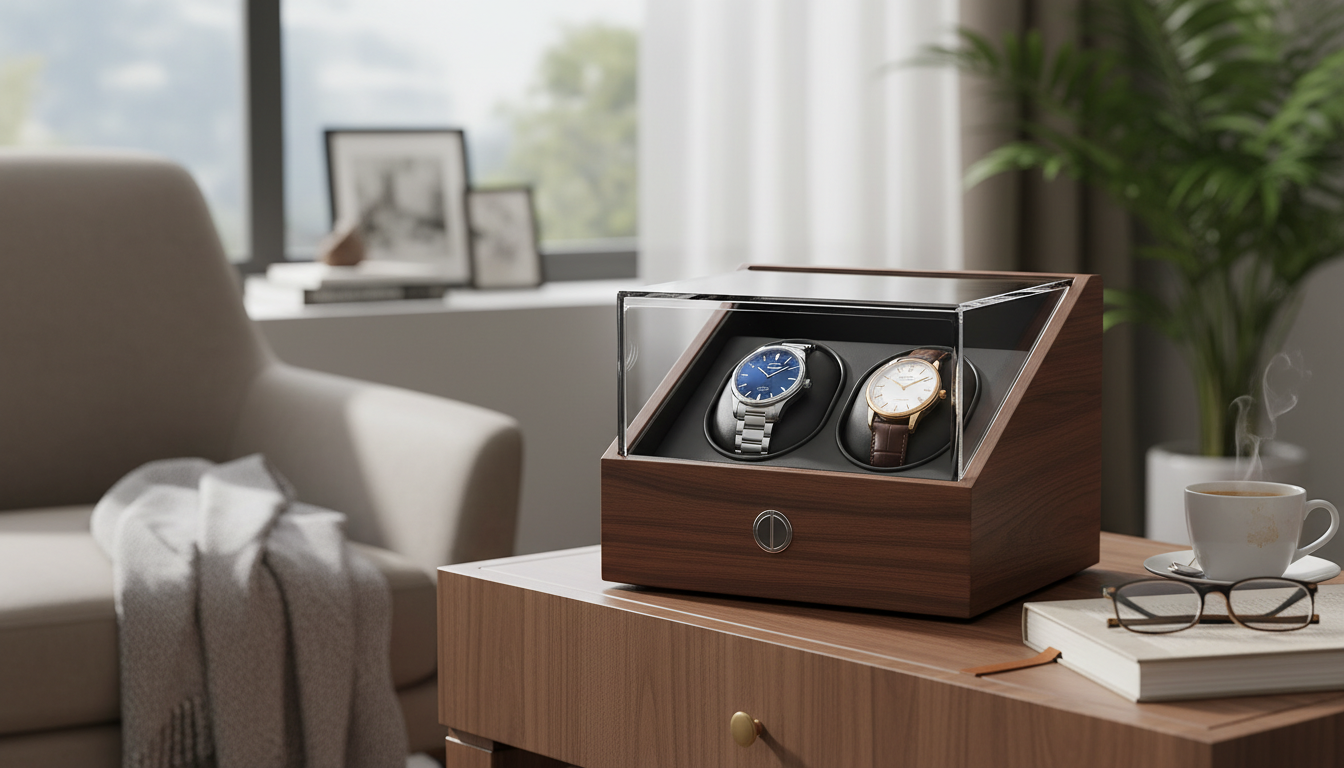
Dual winders come in three primary architectures. Understanding the mechanics helps you fit very different watches—dress pieces and divers—on the same chassis without compromise.
| Build type | Best for |
|---|---|
| Independent dual rotors | Different calibers (e.g., 650 TPD CW vs 900 TPD bi‑directional) and alternating wear patterns. |
| Shared drum | Two watches with near‑identical specs; compact spaces like nightstands. |
| Single motor, alternating | Energy efficiency and simplicity with moderate program flexibility. |
Fit and security matter. Quality holders use a low‑density foam cuff that expands gently. Typical size support: case diameter up to 56–66 mm, thickness near 20 mm, and bracelet perimeters under ~195 mm. The door or cover—acrylic or glass—should latch securely to prevent vibration and dust ingress during cycles.
Avoid holders that pinch bracelets or force oversized lugs. A lock‑in cuff that “clicks” into the drum keeps the watch steady while reducing strap stress.
If you prefer natural textures and warmer tones, explore wood-cased alternatives with veneers like ebony or bamboo; they pair technical winding with décor‑friendly finishes that suit living rooms and studies.
Two automatics seldom share identical winding specs. That’s where individually programmable rotors shine: enter each watch’s TPD, direction, and schedule once, then save it. Many units add a power‑reserve mode, letting stored energy deplete before cycles begin—handy for watches that are worn irregularly.
| Seat | Program snapshot |
|---|---|
| A | 650 TPD, CW, 10 s start delay, 30 min run / 30 min rest cyclical, 6 h nightly sleep. |
| B | 900 TPD, bi‑dir, intermittent 5 min run / 10 min pause, 12 h active window aligned to your day. |
If your two‑watch setup is a stepping stone toward a larger vault, review our larger-capacity winders selection to compare scaling paths and decide whether to start dual today and expand later.
Some controllers count actual turns rather than estimate runtime. Accurate counting ensures each seat hits its exact TPD target across months of use.

Placement dictates priorities. On a nightstand, a winder’s acoustic signature must be whisper‑low—often rated under ~5 dB—so sleep is uninterrupted. In a safe, battery power and compact depth matter more. On display at Home, finishes and lighting elevate presentation while shielding from dust.
| Material/feature | Benefit for winding context |
|---|---|
| High‑gloss wood (ebony/bamboo) | Warm, furniture‑grade look for living rooms; easy to dust; stable base. |
| Carbon fiber finish | Modern, scratch‑resistant surface; light visual footprint on desks. |
| Leather wrap | Tactile touch; dampens resonance; pairs well with office décor. |
| LED ambient light | Soft illumination for nighttime viewing; ensure a physical switch. |
If used in a safe, favor battery or dual‑power units and confirm the case depth leaves clearance for door swing and ventilation.

Selecting the right specification for a double watch winder starts with the movements you own, then layers on placement, power, and materials. Use the checklist below to filter options quickly.
| Movement profile | Starting TPD & direction (guide) |
|---|---|
| Three‑hand/date | 600–800 TPD, bi‑directional |
| Day‑date / GMT | 650–900 TPD, bi‑directional |
| Chronograph | 700–1,000 TPD, CW or bi‑directional |
Looking for a furniture‑grade dual unit? See an oak‑tone dual model that combines quiet winding, LED lighting, and secure cuffs for two contrasting movements.
It’s a powered device that rotates two automatic watches on programmable schedules. By delivering the correct turns per day and direction with intermittent rest and sleep phases, it maintains power reserve and calendar settings so your watches stay ready without manual winding.
If you wear multiple automatics, a dual saves time by keeping both wound and synchronized. Independent seats mean mismatched TPD/direction can be programmed separately. For a refined green‑accent option, explore a green‑accent two‑watch winder suited to display shelves and desks.
Unlike passive storage, a dual winder actively preserves power reserve and settings. Compared to manual winding, it applies controlled, repeatable motion—useful for date, GMT, or moonphase pieces—while cushioned cuffs prevent bracelet strain during rotation and rest periods.
Start at the movement’s recommended TPD (often 600–900) and bi‑directional if supported. Enable pauses and a nightly sleep to mimic daily wear. For a slate‑toned unit with granular presets, see the slate‑hued two‑slot design that stores multiple profiles.
Dust the case, keep vents clear, and verify cuffs remain snug. Review programs each time you switch watches. If bedroom‑placed, switch off LEDs at night and confirm noise remains whisper‑low. Prefer natural textures? Consider this bamboo double option with quiet drive and soft interior.
Quality units keep magnetic components away from rotors, use soft cuffs, and run intermittent cycles. Avoid placing speakers or strong magnets nearby. Set only the required TPD; over‑winding a modern slipping bridle is rare, but unnecessary motion still adds wear.
A double watch winder earns its place when it delivers accurate TPD, independent programs, and near‑silent motion—all in a secure, display‑worthy case. Use the guidance above to match movement data, space, and finish, then compare an orbital‑themed double unit for balanced aesthetics and control. Ready to keep both pieces set? Choose the configuration that fits your routine.


