


Carbon Fiber Watch Winder

A Carbon Fiber Watch Winder ends the daily reset ritual many owners face. By choosing a Carbon Fiber Watch Winder, you keep automatic movements wound, guarded from magnetism, and ready on demand without hand‑setting date, moonphase, or GMT complications.
The difference is measurable: programmable TPD matches your caliber’s needs; bi‑directional cycles prevent rotor wear; and a quiet motor maintains sub‑10 dB operation for desk, nightstand, or safe use. Below, compare modules, noise levels, programs, and power modes to select the right winder with carbon fiber structure for long‑term accuracy and display.
Scroll for configuration guides, capacity comparisons, and pro tips on setup, placement, and care.
When an automatic sits idle, its mainspring unwinds and lubricants can thicken over time. A winder delivers consistent, low‑stress motion that mimics the wrist without overdriving the rotor. Carbon fiber’s rigid shell and low mass add stability to the winding module, reducing micro‑vibrations that can translate into noise and premature wear.
| Movement profile | Direction | Typical TPD |
|---|---|---|
| Bi‑directional efficient rotor | Alternating (CW/CCW) | 650–800 |
| CW‑biased rotor (two‑way capable) | CW or Alternating | 800–1000 |
| CCW‑sensitive winding | CCW or Alternating | 900–1200 |
A winder is not about “more rotation”—it’s about precise dosing of energy, with long rests to respect the mainspring and keep calendar modules synchronized.
If you don’t know your caliber’s TPD, start at 700 alternating. After 48 hours, check reserve. Increase in 100‑TPD steps only if the watch loses time off‑wrist.
Want to compare active rotation across more formats? Explore the broader world of automatic winders in our range of powered remontoirs to benchmark program logic, noise ratings, and module design.

From a single watch station to cabinets with 12 modules, capacity changes more than storage—it alters how you schedule rotation and noise distribution. Independent motors per bay mean you can set unique TPD and directions for each timepiece, while shared‑motor arrays trade some independence for compact footprints.
| Setup size | Best for | Notes |
|---|---|---|
| Single | Daily wearer rotation; desk placement | ultra‑quiet motor, smallest footprint |
| Dual | Two automatics with different TPD needs | Separate or shared timing, compact case |
| 4–6 modules | Small collection; alternating weekly wear | Room for locking glass, drawers |
| 8–12 modules | Multiple complications; safe or cabinet install | Noise planning and independent control matter |
Large‑dial or thick dive pieces need adjustable cuffs. Look for pillows that expand from ~45 mm to 60 mm lug‑to‑lug with firm lateral support to avoid wobble.
If you only need one bay with full programmability, compare compact one‑watch options in our single‑station references—useful when pairing a daily automatic with a quartz lineup.
Placement determines the right power, noise, and security profile. At the desk, sub‑10 dB quiet drive matters most. In a safe, battery life and anti‑magnetic construction are key. In a cabinet, consider locking doors, tempered glass, and ambient lighting that won’t heat the case.
| Location | Power choice | Security & display |
|---|---|---|
| Desktop / dresser | AC preferred; USB‑C for cable management | Glass top, quick‑view access, soft lighting |
| Inside a safe | 2 AA or AC via pass‑through; sleep timers to save power | Locking lid; anti‑magnetic linings; compact chassis |
| Display cabinet | AC continuous; staged start to avoid inrush | Tempered glass doors; keyed lock; dust control |
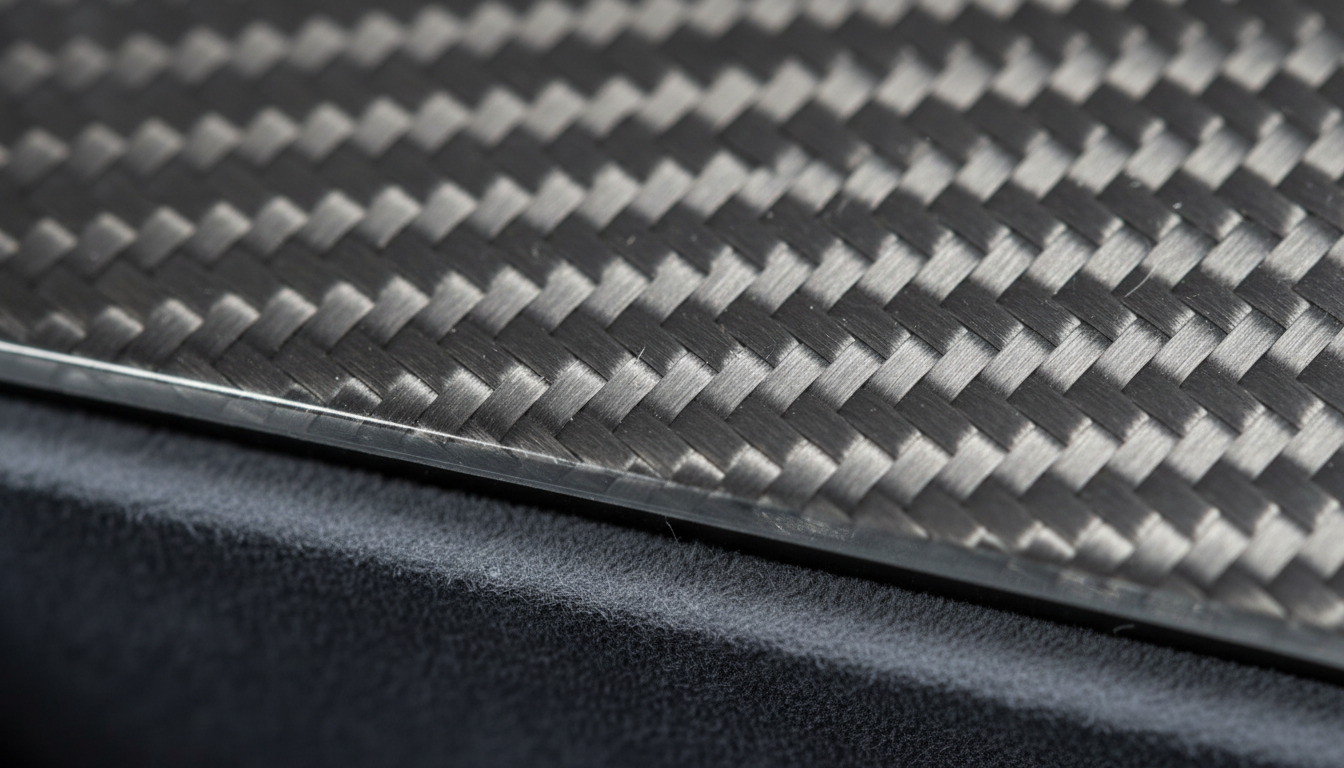
Carbon fiber’s stiffness‑to‑weight ratio helps damp drivetrain resonance. Less vibration means lower perceived noise and steadier rotation cadence.
If you’re storing quartz or hand‑wound pieces that don’t need motion, consider carbon‑fiber watch boxes for passive protection—then reserve the active bays for automatics that benefit from rotation.
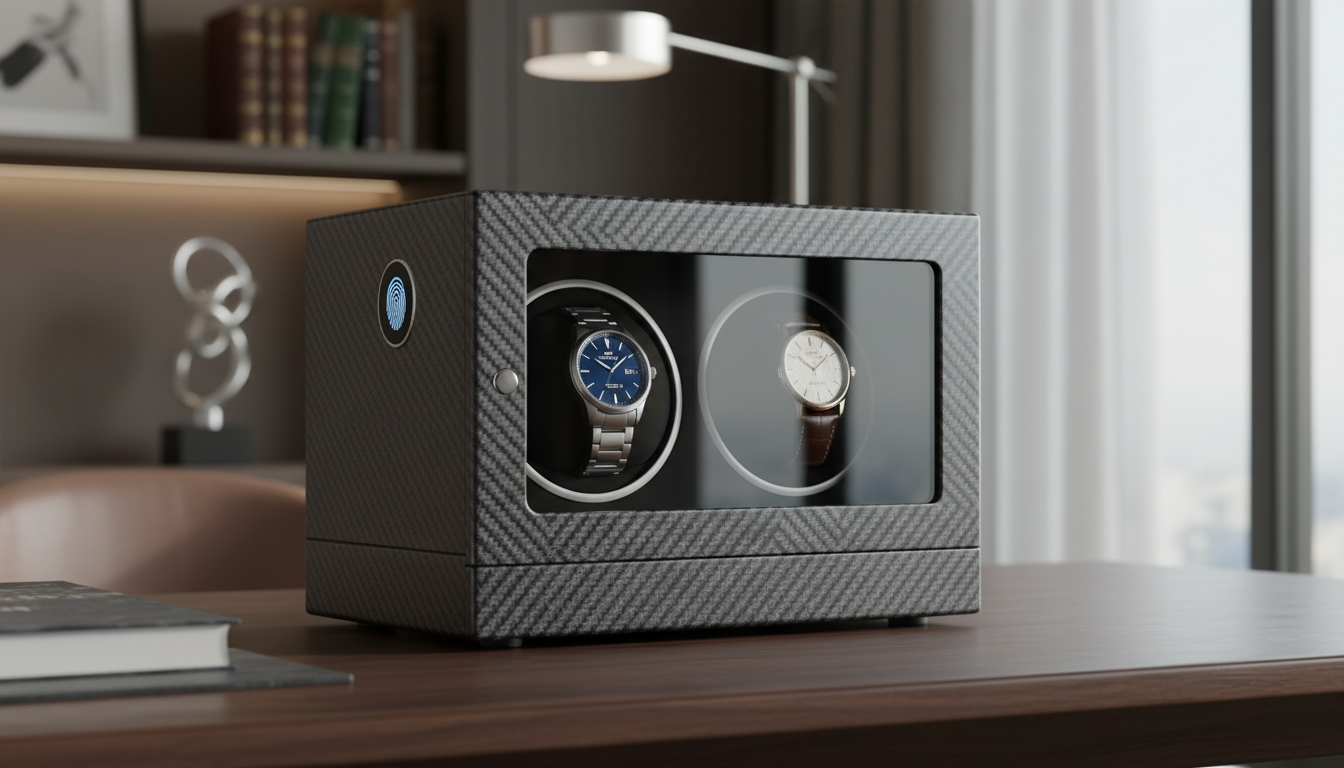
Match the winder to your movements and environment. Use this checklist to get rotation right from day one.
| Criterion | Recommendation |
|---|---|
| Daily wear swap | Single module, alternating 700 TPD, sleep from 22:00–06:00 |
| Complications heavy | programmable TPD per watch, independent modules, locking door |
| Safe install | Battery mode, anti‑magnetic panels, compact chassis |
For a compact desk solution with alternating programs and low‑noise isolation, see this single‑bay carbon unit and compare its TPD presets to your calibers.
It’s an active rotation device that keeps automatic watches wound by simulating wrist motion. Carbon fiber casing adds light, rigid structure that reduces vibration and noise. Look for programmable TPD, bi‑directional modes, anti‑magnetic construction, quiet operation, and cushions sized for large and small cases.
Passive boxes protect from dust, but they don’t maintain the mainspring. A winder preserves calendar settings, keeps oils distributed, and avoids frequent crown manipulation. Carbon fiber helps damp motor resonance and keeps the chassis compact for desks, safes, and cabinets while delivering stable rotation.
Single stations minimize noise and footprint; multi‑module setups add independent programming for several automatics. If you plan to grow, consider a model with scalable modules like this expansion‑friendly single so you can add capacity without changing your TPD logic.
The weave’s rigidity lowers chassis flex, improving gear alignment and reducing chatter. It’s also temperature‑stable and scratch‑resistant. That means lower perceived noise, better motor longevity, and a sleek black finish that pairs well with smoked or clear glass display lids and locking hardware.
Begin with alternating direction around 700 TPD. After 48–72 hours, if the watch still gains reserve comfortably, you’re set. If it loses reserve, raise TPD by 100. If it over‑winds or runs hot, reduce TPD. For a pre‑tuned option, evaluate the presets on this alternating‑cycle variant.
One per automatic you want kept ready. Place singles on the desk or dresser; larger arrays belong in a cabinet or safe. For multi‑watch rotation with added storage, review a four‑bay carbon layout such as this 4‑module configuration and map TPD per watch.
A Carbon Fiber Watch Winder brings together controlled winding, low noise, and protective display so your automatics stay set and wearable at a moment’s notice. Choose capacity by your rotation plan, match TPD and direction to each caliber, and place modules where silence matters most.
Ready to configure your setup? Consider the compact precision of this carbon single, then explore advanced modules and safe‑ready formats via the guides above.


