


3 Watch Winder

If your automatics stop when left off the wrist, a 3 watch winder keeps three timepieces running, synchronized, and ready to wear. A 3 watch winder uses controlled rotation to maintain power reserve, preserve lubrication, and prevent calendar drift, so you avoid constant resets and crown wear.
With independent heads, adjustable TPD (turns per day), and bi‑directional programs, this category is built for mixed collections—dress, diver, or GMT—each requiring different cycles. Expect whisper‑quiet motors, dust protection via a sealed glass door, and optional storage that declutters your dresser or safe. Explore the guidance below to match rotation, noise, and security to your routine.
Automatic movements are energized by a rotor; when a watch rests, the mainspring relaxes and oils can settle. A dedicated winder replicates wrist motion in a measured way. The triple format adds independent modules, so each piece receives the precise regimen it needs without compromise.
Unlike passive storage, a triple winder keeps complications—moonphase, annual calendar, dual time—correct. It reduces repetitive crown manipulation that can stress stems and gaskets, extending service intervals in real‑world use.
| Criterion | Without a winder | With a triple winder |
|---|---|---|
| Readiness | Frequent resets, date and GMT out of sync | Always on time, calendars accurate |
| Lubrication | Oils may settle with long stops | Regular motion keeps oils distributed |
| Crown wear | Repeated manipulation over time | Less handling, reduced stress |
Set alternating direction for bi‑directional calibres and choose a TPD near the maker’s guidance; if unknown, start at 650–800 with a daily sleep block to maintain reserve without saturation.

A single unit maintains one favorite. A dual covers an everyday pair. A triple consolidates three automatics with independent control in one housing—crucial when each watch needs different TPD and direction. If you alternate a dress piece, a diver, and a GMT, the triple format avoids compromises.
| Format | Best for | Advantages |
|---|---|---|
| Single | One daily automatic | Compact, lowest power use |
| Dual | Two‑watch rotation | Balance of size and function |
| Triple | Three distinct calibres | Independent heads, unified display and storage |
Typical triple dimensions still suit shelves: around Width 52 cm, Height 35 cm, Depth 41 cm, Weight 5.6 kg, depending on materials and storage. If you want a broader overview beyond triple units, see a selection of automatic winders to compare formats side by side.
Many triple housings offer three‑zone storage: a 3‑head winder plus drawers for straps or tools, keeping accessories together and dust‑free.
Placement drives priorities. On a nightstand, sub‑audible operation matters; look for motors rated under ~10 dB and decoupled mounts. In an office, presentation counts: high‑gloss lacquered cases, carbon‑fiber façades, or full leather wraps with LED lighting elevate display behind a glass door.
| Feature | Why it matters on a triple |
|---|---|
| Noise rating | Three heads cycle often; isolation and low‑dB motors keep bedrooms serene |
| Power redundancy | AC for consistency; battery allows placement away from outlets or in a safe |
| Storage integration | Top storage area or drawers for straps, tools, and spare bracelets |
| Security | Fingerprint access and sealed door deter dust and casual handling |
Prefer the warmth of wood? Explore wood‑cased options to match heritage interiors while keeping rotation precise and display refined.
If placing in a safe, confirm internal dimensions and ventilation. Some safes need AC pass‑through or long‑life battery operation to maintain programs reliably.
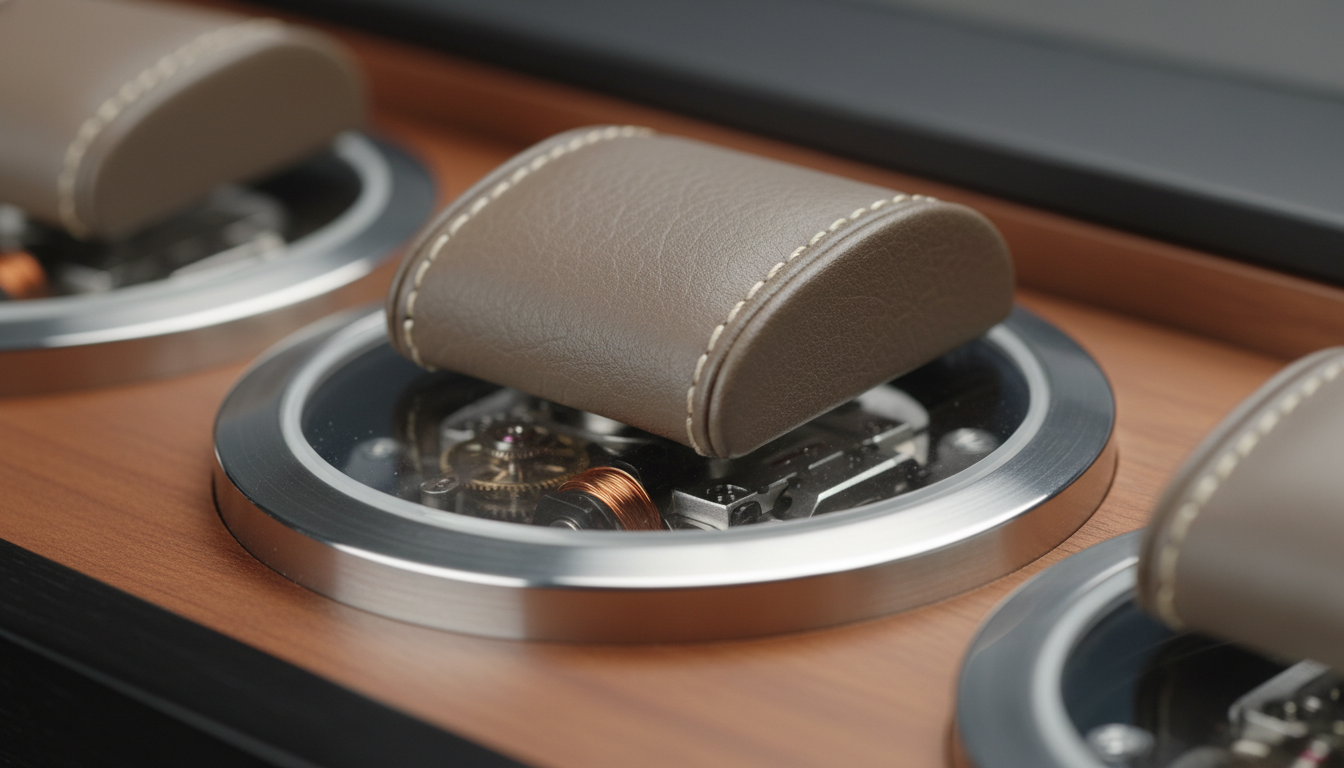
A quality winder does not “spin nonstop.” It follows intermittent cycles: rotate, rest, and sleep. This mirrors everyday motion and protects reversers and clutches. The triple format adds scheduling per head—vital when a chronograph module wants different rest windows than a simple three‑hander.
| Complication | Typical direction | TPD range to trial |
|---|---|---|
| Three‑hand/date | Alternating (CW/CCW) | 600–800 |
| GMT/dual time | Alternating favored | 650–900 |
| Chronograph/annual | Check maker’s note; often alternating | 700–1,000 |
Scaling beyond three? Consider eight‑head units that mirror the same programmable logic across larger collections while consolidating power and dust control.
“Intermittent rotation with well‑timed rests sustains reserve without stressing reversers—exactly what a refined triple program is built to do.”

Prioritize rotation intelligence, silence, security, and materials. A good 3 watch winder balances all four without excess bulk.
| Selection criterion | What to look for |
|---|---|
| Rotation control | Independent heads, fine TPD steps, bi‑directional modes, sleep |
| Silence | Low‑dB motors, damped mounts, smooth gear profiles |
| Security & access | Fingerprint lock, PIN, or keyed access; stable hinges; sealed door |
Love bold color? Consider a malachite‑hued triple where rotation meets statement design—see this malachite finish triple unit as an example of strong aesthetics matched to precise programs.
Prefer piano black? High‑gloss housings pair elegantly with a sealed door and LED accents; a model like this high‑piano‑gloss variant demonstrates controlled TPD steps, quiet drives, and balanced storage layout.
It is a powered cabinet with three independent rotating heads that keep automatic watches wound. You control TPD, direction, start delay, and sleep cycles so movements stay punctual. Quality models feature quiet motors, cushioned holders, and dust protection via a sealed glass door and lined chambers.
If you rotate three automatics, a triple consolidates power, protection, and programming in one housing. Each head runs its own regimen—critical when watches demand different TPD and directions—while storage and security features reduce clutter and safeguard bracelets and cases.
A display box stores; a winder stores and rotates. Look for rotation programs (alternating CW/CCW), sleep modes, and noise control. Interior details—velour lining, memory‑foam pillows, and a glass door—enhance presentation while preventing dust and micro‑scratches during everyday access.
Start alternating direction around 650–800 TPD, then fine‑tune. For complex calendars or GMTs, increase incrementally while keeping a daily sleep window. If you like a deep, rich finish, review a triple in crimson lacquer to see how refined housings pair with granular TPD controls.
Well‑engineered drives operate below typical ambient noise, with damped mounts to curb vibration. Many users place them bedside without disturbance. For sport‑inspired styling with low‑dB performance, consider a triple in a motorsport‑styled housing featuring isolated motors.
Dust the exterior, clean the glass with a soft cloth, and vacuum lint from velour occasionally. Check clamps for snug fit, verify TPD quarterly, and update sleep timing with seasonal routines. Keep magnets and speakers away, and ensure stable AC power or fresh batteries if placed in a cabinet or safe.
A well‑specified 3 watch winder blends precise rotation, low noise, and protective storage to keep three automatics set and ready. Choose independent heads, bi‑directional programs, and a secure, sealed housing that suits your space. For travel or a smaller setup, a compact two‑head winder offers complementary flexibility alongside your main triple.


