


Confused about whether a piece is real solid wood or just a thin skin on a core? You’re not alone. In 2026, mixing materials is the norm, so learning to identify wood veneer accurately saves money, avoids mistakes, and improves maintenance.
This guide explains the definition of wood veneer, the real benefits you can verify, and step‑by‑step ways to identify it on furniture, cabinet doors, architectural panels, and flooring—right in the store or at home.
Clarity first: the true meaning
Start by nailing the definition. That’s how you identify materials consistently and avoid mixing veneer with laminate or solid wood. Keep it simple and visual.
- Wood veneer = a thin slice of real wood (often 0.6–1.2 mm) bonded to a core (MDF, particleboard, or plywood).
- Solid wood = wood throughout, not just at the surface; the end grain and edges are the same species.
- Laminate = a printed surface on a composite core; the “grain” repeats with no pores you can feel.
- Plywood = cross‑laminated wood veneers glued in layers; often used as a stable core.
- Engineered wood = umbrella term for products like MDF, particleboard, and hardwood plywood.
Veneer is real wood on the face. If you see a perfect, printed pattern with no open pores, you’re not looking at wood veneer—likely laminate.
With the definition clear, you can identify the surface layer quickly—and then verify the core beneath it.

Edges: the fastest giveaway
Most items reveal their construction at the edges. A 10‑second scan often lets you spot veneer versus solid wood without tools.
- Edge banding line: a thin strip at the edge signals veneer on a composite core beneath.
- End grain test: solid wood shows true end grain on a cut end; veneer usually wraps long grain over edges.
- Plywood tell: look for stacked layers (cross‑bands) on an exposed edge—this is hardwood plywood core.
- Lipping vs banding: a thick solid strip (lipping) up to several millimeters differs from ultra‑thin banding.
- Mitered corners: if the “grain” wraps perfectly around a sharp corner, it’s often veneer or laminate.
| Edge observation | Likely material |
|---|---|
| Thin strip, visible glue line | Veneer with edge banding on MDF or particleboard |
| Stacked layers visible | Hardwood plywood core with face veneer |
| Continuous end grain through thickness | Solid wood |
Run a fingernail along the edge. If you feel a subtle lip, it’s likely banding. Use this to identify veneer quickly in stores.
Edges are your quickest way to identify construction. Confirm with surface and underside clues next.
Surfaces: grain, pores, and repeats
Real wood, whether thick or thin, shows natural variation. Use sight and touch to distinguish wood veneer from printed facings and to recognize solid panels.
- Grain continuity: on tops and sides, the pattern should change logically across panels. Identical repeats hint at laminate.
- Open pores: oak and ash show tactile pores. If it’s perfectly smooth yet “woody,” suspect a printed surface.
- Book‑match seams: mirrored “cathedrals” suggest wood veneer leaves placed side by side from one flitch.
- Tap and weight: composite cores feel uniform and tap less “ringy” than thick solid wood slabs.
- Finish witness lines: micro seams reveal panel construction under the finish—common with veneered cabinetry.
Never plan to sand “deep” during refinishing unless you’ve confirmed thickness. Most veneers are thin; aggressive sanding risks a sand‑through.
These surface cues help you identify veneer confidently—even when the edges are concealed.

Undersides: verify the core
Flip, open, and look inside. The underside, back, or interior of cabinet doors often reveals the substrate and confirms your identification.
- Back panels: a plain face with fiber specks = MDF; visible chips = particleboard; cross‑bands = plywood.
- Screw holes: crumbly particles at holes indicate composite cores; continuous fibers point to solid wood.
- Shelf undersides: edge banding at the back edge confirms a veneered shelf.
- Drawer boxes: solid wood boxes show dovetails and end grain; veneered drawer fronts hide the core.
- Panel symmetry: quality pieces veneer both sides for balance—warp resistance is a benefit you can see.
Composite wood products follow emission standards for formaldehyde. Labels such as “no‑added formaldehyde” indicate lower off‑gassing cores under the veneer.
Use these underside checks to identify veneer construction in kitchens, architectural doors, and built‑ins.
Cuts and matches: reading the face
Recognize how veneers are sliced and arranged. This helps you identify quality, understand aesthetics, and spot engineered or reconstituted options.
- Crown cut: broad “cathedral” arches—common on statement panels.
- Quarter or rift cut: straighter, linear grain with fleck minimized—favored for uniformity.
- Rotary: long, wide sheets; often used in plywood cores rather than show faces.
- Book‑matched: mirrored pairs from the same flitch; seams appear like butterfly wings.
- Reconstituted veneer: highly consistent color and grain; few defects; useful for large, uniform runs.
To identify matching, sight along seams. If the “cathedrals” mirror perfectly panel to panel, it’s book‑matched from consecutive leaves.
Reading cuts and matches helps you identify design intent and judge whether the material fits your space.
Benefits you can confirm
Understanding benefits is not sales talk if you can verify them on the piece. Here’s how to link claims to what you see and feel in 2026 showrooms.
- Stability: large, flat panels (cabinet sides, wardrobe doors) stay true when veneered on both faces over plywood or MDF.
- Sustainability: one tree yields many leaves; look for consistent species labeling and balanced construction.
- Design flexibility: complex curves, ultra‑wide doors, and precise grain alignment are easier with veneer than with solid wood.
- Edge protection: quality wood veneer edge banding shields cores and matches the face.
- Cost control: expansive surfaces in matching grain—common in architectural doors—signal efficient veneer use.
Water is the enemy of composite cores. If you identify veneer in wet zones, seal edges carefully and avoid standing moisture.
Use these checks to identify genuine benefits rather than relying on vague product claims.
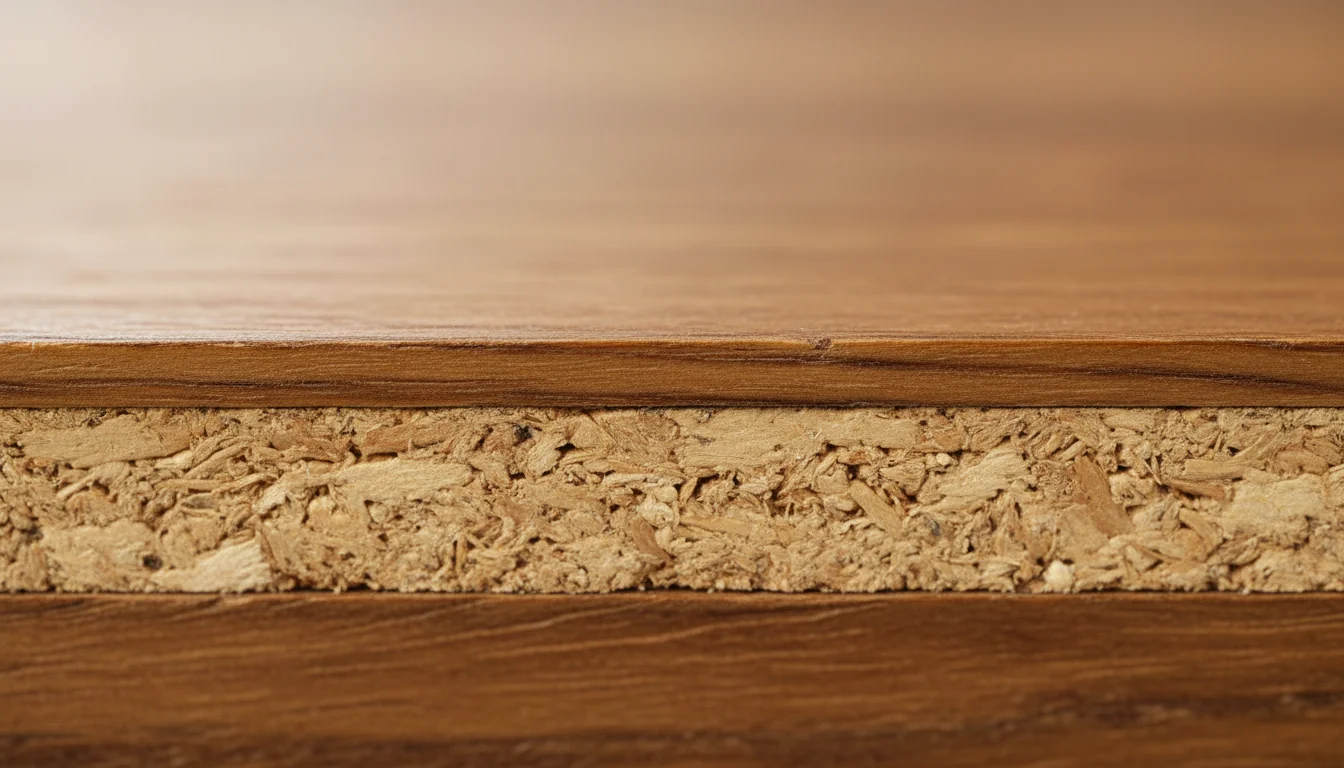
How to tell veneer from solid wood: a 5‑step check
- Scan edges: look for banding lines or plywood cross‑bands.
- Inspect the end: true end grain = solid; wrapped long grain = veneer.
- Read the surface: repeated patterns suggest laminate, not veneer.
- Check the back/underside: confirm MDF, particleboard, or plywood cores.
- Tap and weigh: uniform feel = engineered core; lively ring = thick solid.
Use at least two independent clues before you identify the build. Edge + underside is a reliable pair.
Don’t assume “heavy = solid.” Plywood and thick MDF can be heavy. Always verify before you identify.
Veneer vs laminate vs solid: quick compare
A short, mobile‑friendly comparison to help you identify materials at a glance and pick the right expectations for use and care.
| Material | How to confirm |
|---|---|
| Wood veneer | Real pores and grain; edge banding; MDF/particleboard/plywood core on the back. |
| Solid wood | End grain visible through thickness; no banding; consistent species at edges and ends. |
| Laminate | Printed, repeating pattern; plasticky feel; no open pores; banded edges over composite core. |
For the pros: request clear descriptions of veneer cut, matching (book, slip), and core (hardwood plywood vs MDF) to identify suitability.
Edge banding: small strip, big clue
Edges protect cores and reveal construction. Discover the benefits of wood veneer edge banding in your woodworking projects and learn to recognize good execution.
- Color and grain match: high‑quality banding aligns with face veneer species and direction.
- Thickness: thicker, real‑wood banding resists chips better than ultra‑thin tape.
- Corners: cleanly trimmed banding at inside corners indicates careful work.
- Heat and moisture: sealed banding edges slow swelling on particleboard and MDF.
Run a light across the edge. A uniform sheen without gaps suggests strong adhesion—another way to identify quality.
What does “wood veneer” mean, precisely?
A thin slice of real wood bonded to a core such as MDF, particleboard, or hardwood plywood. You identify it by real grain and pores on the face plus signs of a composite core.
How do I tell veneer from solid wood fast?
Check edges and ends. End grain through the thickness indicates solid wood. A thin band at the edge with MDF or plywood beneath lets you identify veneer quickly.
Is veneer worse than solid wood?
Different, not worse. Veneer over engineered cores excels on large, flat panels for stability and design consistency. Identify balanced construction to ensure durability.
Can I refinish a veneered top?
Yes, but gently. Veneer is thin. Confirm thickness and identify the finish first. Use light sanding or chemical stripping to avoid sand‑through.
What about emissions and safety?
Composite cores must meet formaldehyde limits. Look for low‑emission claims like “no‑added formaldehyde.” Identify the core on the back panel to verify.
How do I spot high‑quality veneer work?
Even seams, matched grain, veneer on both faces, and solid lipping at stress points. Identify these cues on cabinet doors and large architectural panels.
Is laminate the same as veneer?
No. Laminate is a printed layer; veneer is real wood. Identify laminate by perfectly repeating patterns and a plastic‑smooth feel with no open pores.
Once you grasp what wood veneer is and how it’s built, you can identify it confidently anywhere—showroom, jobsite, or home. Verification beats guesswork every time.
- Use edges and undersides to confirm the core.
- Read grain, pores, and seams for surface truth.
- Link visible construction to real‑world benefits.
Apply these quick checks in 2026 and beyond, and you’ll identify wood veneer like a pro—calmly, accurately, and fast.
0 comments