


Wondering which watch winder to choose for a Rolex Submariner 40? You are not alone. This diver is robust, yet its needs are specific.
In this 2026 guide, you will learn the exact settings, what truly matters for a Submariner (Date and No Date), how to avoid wear, and how to set up your winder in minutes.
Ready to keep your Sub running on time without overthinking it? Let’s go straight to the essentials.
Movement basics: ideal winding
A 40mm Submariner—Date or no‑date—uses an automatic Oyster Perpetual movement designed to wind efficiently on wrist. On a winder, aim for bidirectional rotation and a moderate turns‑per‑day target.
- TPD around 650: a widely accepted sweet spot for modern Rolex automatics.
- Winding direction: both clockwise and counterclockwise to mimic wrist motion.
- Power reserve: ~70 hours for current Submariner calibres; you can skip the winder for short breaks.
- Date handling: keep the calendar running if you change watches frequently.
Before using a winder, fully wind the watch by turning the crown clockwise for 35–40 rotations. Then mount it and let the program maintain, not “charge,” the spring.
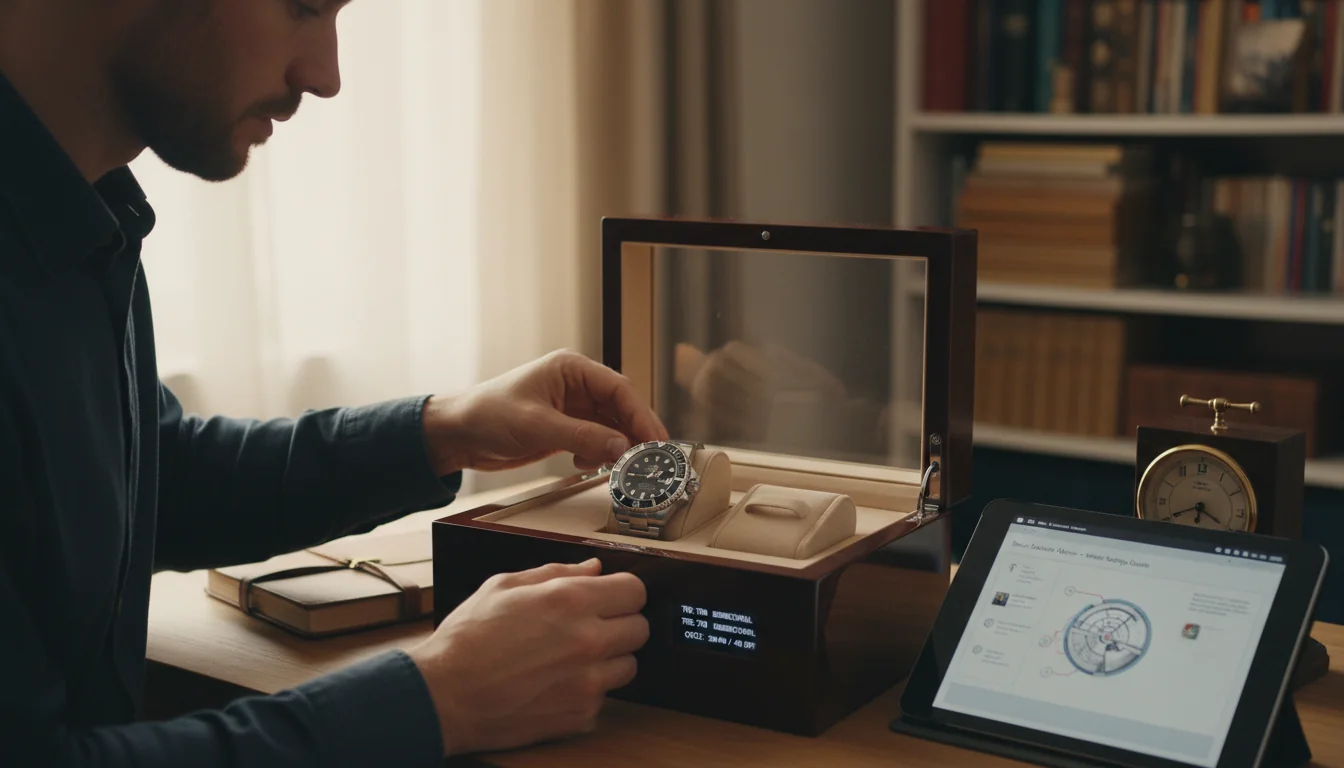
Set your winder to alternate directions with regular rest periods. This mirrors daily wear and avoids unnecessary motion while keeping the Submariner ready to wear.
Precise settings: TPD and direction
The most common question: “What exact winder settings should I use for a Submariner 40?” Here is a straightforward, field‑tested baseline that aligns with watch‑care guidance and community consensus.
- Target TPD ≈ 650. Many units achieve this via 900–1,200 programmed turns with alternating direction (half each way).
- Winding direction: bidirectional. The movement harvests energy in either direction.
- Include rest intervals to prevent constant motion; a 12–16 hour daily active window is ample.
- Power‑reserve delay (if available): 6–24 hours lets the watch release stored energy before cycles begin.
For most Oyster Perpetual three‑hand models, ~650 TPD, both directions, keeps the mainspring comfortably within its working range.
Prefer a clear case to showcase the watch while it turns? Explore our acrylic automatic winder selection for a transparent, display‑friendly approach that still respects Submariner settings.
Ultra‑cheap units may over‑rotate, buzz audibly, or use weak belts. Choose quiet motors, reliable controls, and stable cushions to protect the Submariner’s case and bracelet.
If your schedule varies, increase rest time rather than cranking up TPD. The goal is readiness, not constant spinning.
Fit and support: cushion matters
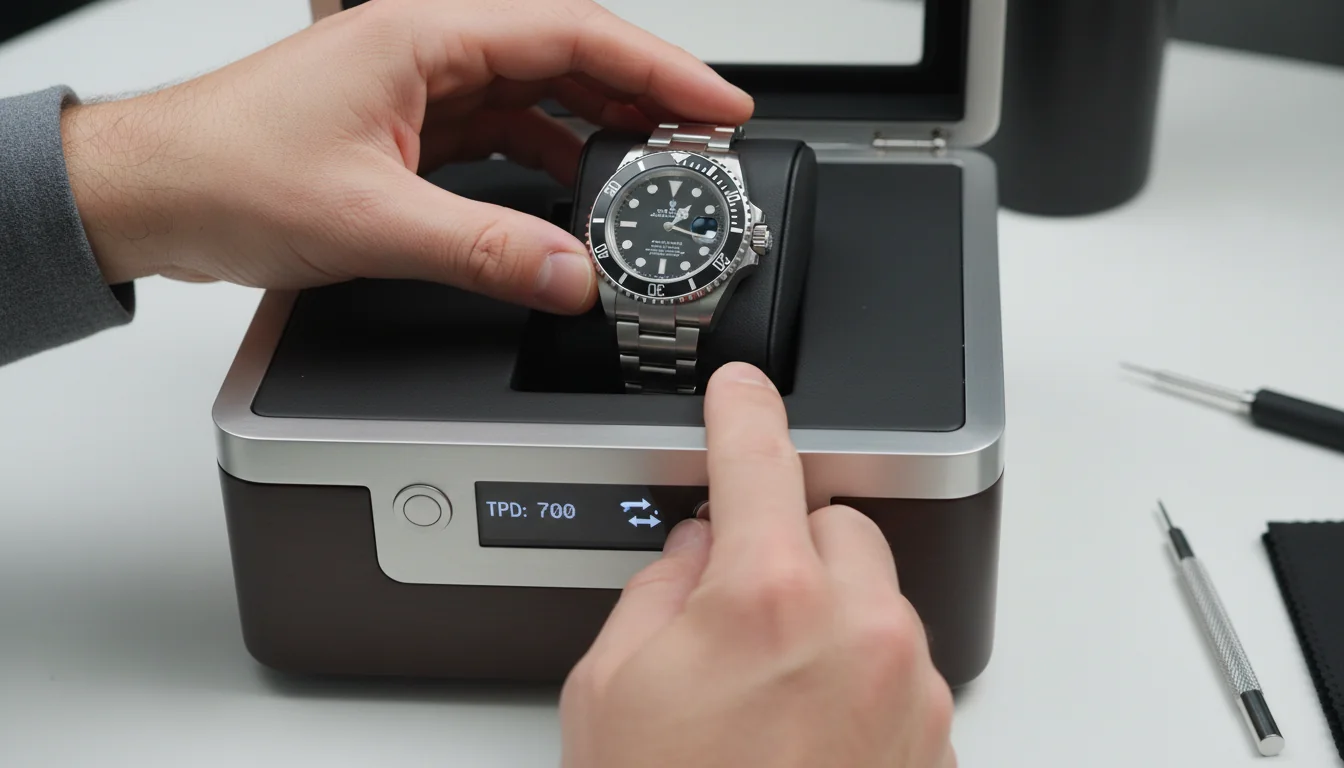
The Submariner’s 40mm case and Oyster bracelet need a stable mount. A loose cushion causes wobble; an oversized one strains the clasp. Prioritize a secure, pressure‑free fit.
- Self‑conforming cushions reduce pressure points on polished flanks and end‑links.
- Adjustable cuffs accommodate micro‑adjust clasps and bracelet taper.
- Firm engagement prevents the watch from slipping during counterclockwise cycles.
- A snug fit keeps the Submariner balanced in both directions.
| Setting | Submariner 40 |
|---|---|
| Winding direction | Both (bidirectional) |
| TPD baseline | ~650 turns/day |
| Crown wind (manual) | 35–40 clockwise turns from stop |
| Date caution window | Avoid quick‑set ~8pm–4am |
Mount the Submariner on the cushion at your normal clasp setting. If the clasp fights you, size the cuff smaller rather than forcing the bracelet.
Left‑hand wearers can use the same settings. The Sub’s rotor efficiency doesn’t depend on which wrist you prefer.
Noise, cycles, and placement
On a nightstand, the wrong winder can be distracting. Prioritize quiet operation, intelligent cycle design, and a safe location for your dive watch.
- Quiet motors with smooth starts reduce vibration and hum.
- Use programmed rest to keep average motion near your target TPD.
- Avoid strong magnets and speakers; keep the Submariner away from drivers.
- Ensure steady, level placement to prevent wobble during counter‑rotation.
Do not store a running winder in a sealed safe without ventilation. Heat buildup and humidity can impact lubricants and gaskets.
Forums’ general consensus: with correct TPD and direction, a Submariner can remain on a winder indefinitely. Still, periodic wrist time is healthy.
If you rotate multiple Rolex watches, set each head individually. Avoid “one‑setting‑fits‑all” dials that lack precise control.
Guide 2026: set your winder correctly
Use these compact steps to program a Submariner 40 safely and efficiently.
- Hand-wind the crown 35–40 clockwise turns to full.
- Seat the watch firmly; ensure the clasp is not stressed.
- Set TPD to ~650; choose bidirectional.
- Enable a start delay (e.g., 30–60 minutes) after full wind.
- Program sleep hours overnight; verify timekeeping after 48 h.
If the Submariner sits for weeks, hand-wind to full every few weeks to exercise the mainspring.
Don’t exceed your required TPD by large margins. Extra spinning won’t help accuracy and may add unnecessary rotor wear.
For a subtle wood accent beside a diver, consider a wood-grain single module to house a single Sub daily.
Tight on space? this compact cube keeps a minimal footprint while meeting Submariner settings.
Do I need a winder for a Submariner?
Not if you wear it daily. With about 70 hours of reserve, a routine wrist schedule suffices. A winder is useful if you rotate watches or want the date ready at a glance.
What’s the right TPD and direction?
~650 TPD, bidirectional fits modern Submariner movements well. It winds in either direction; splitting cycles through the day is most natural.
Will a winder overwind my Sub?
Modern autos have slipping clutches that prevent over-tension. Still, keep TPD close to needs, add rest periods, and avoid nonstop 24/7 operation for mechanical sympathy.
Is it safe to leave the Sub on a winder long-term?
Yes, with correct programming and sleep windows. Periodically check timekeeping and re-seat the watch. Consider a subdued dark finish for bedroom use due to visual calm.
What about vintage Submariner dates?
Non-quickset references gain the most from a winder because manual date-cycling is slow. Keep TPD near 600–700 and avoid adjusting the date around midnight.
How quiet should a winder be for a desk or nightstand?
Aim for low mechanical hum with vibration damping. Place on a solid surface. A refined finish like a glossy lacquered unit pairs well with an iconic diver’s silhouette.
My winder was inexpensive. Is it okay for a Sub?
Low-cost winders can work if they hold settings, support the bracelet, and run quietly. If TPD drifts or the cushion is loose, re-check programming or consider a sturdier unit.
For a Submariner 40, the right winder is about accurate settings, secure fit, and smart cycles—not fancy extras.
- Settings: ~650 TPD, bidirectional, with sleep windows.
- Fit: firm cuff, balanced cradle, no bracelet stress.
- Use: hand-wind 35–40 turns first; let the winder maintain.
Prefer a bold accent next to a classic diver? Consider this color-forward single to keep your Sub ready anytime.
0 comments