


Backpacking forces every gram to earn its place. Your watch is no exception—so what’s the smartest way to protect it on trail without adding bulk?
This 2026 guide shows you exactly which watch case to choose for backpacking travel, balancing weight vs protection, water resistance, and pack fit. Short, field-ready tips—no fluff.
Protection first: trail proofing
Backpacking adds hazards your home drawer never does: pack compression, drops on rock, condensation, and campsite grit. A watch case shields crystals, crowns, and bezels from those repeated micro-impacts.
- Impact resistance: foam cradle or molded pod to prevent lateral play.
- Moisture defense: splashproof at minimum for damp tents and wet brush.
- Dust and grit: sealed seams that keep out sand from campsites.
- Pack pressure: a semi-rigid shell to survive compression in your backpack.
Store high and centered in your pack (near your sleeping kit). It minimizes jolts from hip swing and trekking pole strikes when you set your bag down.
If you wear an ABC/GPS watch for navigation, a case still helps at night: it prevents accidental screen presses, keeps straps tidy, and blocks condensation collecting on cold metal.
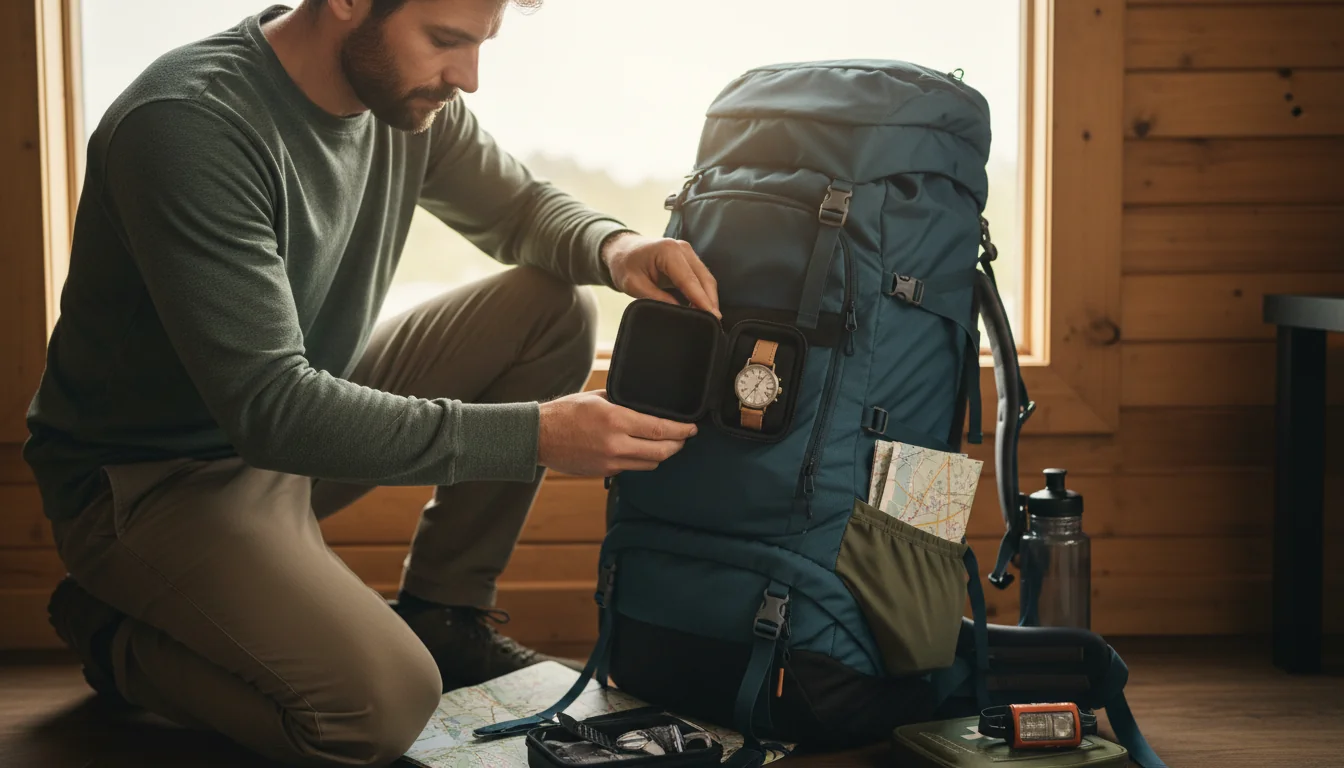
Weight vs. safety: smart materials
Backpacking is a weight game. Choose the lightest case that still resists compression and spray. Materials determine both protection and grams carried over every mile.
| Case type | Best when |
|---|---|
| Semi-rigid shell (polymer + foam) | You need impact control with modest weight for multiday hiking. |
| Soft roll (leather or fabric) | Cabin travel, dry climates, low compression; prioritize packability. |
| Waterproof pouch (drybag style) | River crossings, persistent rain, inclement weather on exposed routes. |
- Aim for under 150 g for a single-watch pod if you count every ounce.
- Seek dense foam or molded cups to stop wristwatch drift inside.
- Prefer YKK-style zips or roll-top seals for spray and dust.
- Avoid bulky hinges; flat seams pack better in a travel backpack.
Rigid polymers can be strong at low thickness. For a sleek, protective alternative, explore our acrylic selection as a lightweight option.
For wet trails and camping nights, prioritize water-shedding exteriors and tight stitching that won’t wick moisture inside.
Capacity choices: trip length
Backpacking favors minimalism. Carry one watch you wear, plus a tiny case for camp or as a just-in-case backup if your ABC/GPS device fails or needs charging.
- Single-watch pod: best for thru-hikes and weekend trips; adds negligible bulk.
- Two-watch micro-roll: viable if you swap between a field watch and a GPS unit.
- Four-slot organizer: consider only for non-technical travel or when combining city stays with short trails.
Large multi-slot cases are great at home base, not in a pack. If you need a home organizer, browse our twelve-slot range and take a compact trail case instead.
Hostels, buses, and shared camps mean more bag handling. Slim cases hide better and reduce attention from opportunistic thieves.

Access and packing: quick, safe, dry
On backpacking trips, you’ll open your pack dozens of times. Your watch case needs to be accessible without exposing it to rain or accidental drops.
- Place high, near the back panel for stability and impact control.
- Use a zip pocket inside the main compartment—not the exterior dump pocket.
- If storms roll in, nest the case inside a small dry bag.
- In hostels, keep the case in your day pouch during check-in/out.
Wrap the case with your puffy at night. It buffers temperature swings that cause condensation in cold valleys.
For hiking and camping routines, treat the case like other small valuables. If you step away, ask a partner to watch bags or use a simple cable lock on your pack frame.
Wet weather and night moves
Backpacking often means damp mornings, river mist, or drizzle at camp. Moisture management matters as much as shock resistance for your case choice.
- Look for sealed seams and a snug closure that resists spray.
- Add 1–2 silica gel packs inside the case to fight humidity.
- Avoid leaving the case on cold ground; use your foam sit pad as a barrier.
- GPS/ABC wearers: case your watch only when sleeping or stowing for transport.
Even “waterproof” shells can pool moisture via temperature swings. Vent the case briefly in your tent vestibule before sealing for the night.
On night moves, you want instant access to timing. Keep the case opening oriented the same way each time so you can operate it by feel with a headlamp.

Waterproofing: rain, rivers, condensation
Even if your watch is water-resistant, the case still protects straps, finishes, and accessories from long exposure to moisture and grit.
- Look for sealed zips or at least storm flaps over the zipper path.
- Double-bag with a small dry bag in river canyons or monsoon seasons.
- Air it out nightly to avoid trapped condensation near crystals and pins.
- Add desiccant packs and rotate them every few days.
Ultralight doesn’t mean unprotected. A slim, water-resistant single-slot case is the sweet spot for most backpacking itineraries.
If you’re moving fast-and-light, place the case inside a liner bag with your sleeping layers. Dry kit cushions impact and buffers moisture swings.
Field guide: choose and pack smart
- List your kit: watch, strap, charger, tiny tool, spare bars.
- Decide capacity: one-slot for most routes; two-slot if mixing city days.
- Pick protection: EVA zip for weight; hard shell for rough transit.
- Test pack: place near top; ensure no crush points.
- Trail test: walk 10 minutes; if you hear rattles, re-pack.
A compact dark single-slot sleeve suits most hikers; consider a matte, low-profile option that nests beside your hydration bladder.
Don’t pack a watch roll under a rigid pot set. The pressure can bend spring bars and mar polished cases over long miles.
Do I even need a watch case for backpacking?
If you keep the watch on your wrist, maybe not. But for hostels, buses, and zero days, a light, protective case prevents scratches and keeps chargers and pins together.
Single-slot or multi-slot for a long trek?
For classic backpacking, a single-slot case is ideal. Add a second slot only if you truly alternate watches between trail and town on the same trip.
Hard shell or soft roll on rough trails?
Hard or semi-rigid wins when your pack is tightly stuffed or tossed in shuttles. Soft rolls work only if they sit in a protected pocket with clothing around them.
What about strap changes during a hike?
Carry a quick-change strap and spare bars. A compact one-watch holder with elastic loops is handy; see a minimal travel sleeve with tool space for inspiration.
Is leather practical for backpacking conditions?
Leather tubes ride well in urban segments and moderate weather. For wet trails, protect it in a liner bag or opt for EVA. A padded leather cylinder works if moisture is managed.
How waterproof should the case be?
Water-resistant zips and tight seams are enough for drizzle. In heavy rain, double-bag. A sleek single-watch holder with covered zipper is a smart middle ground.
Any quick packing tips for backpackers?
Top-load for access, avoid metal crush zones, and silence rattles with a buff. Keep the case in your personal item during transit for security and convenience.
For backpacking, the smartest choice is a light, single-slot case with real crush resistance, decent water protection, and secure organizers for tiny parts.
- Favor EVA or semi-rigid shells over soft rolls inside crowded packs.
- Keep chargers and pins in dedicated loops to avoid loss.
- Pack the case high and dry; double-bag in severe weather.
If your trip mixes trails and city breaks, a compact four-slot organizer can stage your kit between segments; consider a travel-friendly layout with gentle padding before moving one watch into your trail case.
0 comments