


A loose watch box lid cheapens the experience and risks scratches. Do you feel wiggle, hear a click, or see misalignment at the hinge line?
This hands-on 2026 guide shows how to eliminate hinge play at the source—diagnose the type of slack, choose the right fix, and torque fasteners correctly—so your lid closes quiet and true.
Rock-solid lids: eliminate hinge lash
Start by naming the problem. “Play” is movement you don’t intend. Identify where it lives—at the screws, within the pin, or in alignment—so you can remove it completely, not just mask it.
- Axial play: lid slides along the hinge pin end to end.
- Radial play: lid rocks up/down around the pin (rattle).
- Mounting slack: screws shift in enlarged wood holes.
- Geometry drift: hinge leaves misaligned or mortises uneven.
- Stop interference: lid hits the case stop before hinge seats.
Grip one hinge leaf and try to move only the lid. If motion appears before the pin rotates, tighten the fasteners; if the pin moves first, treat the pivot.
Quantify the gap. A standard sheet of printer paper (~0.1 mm) works as a quick feeler. For precision, a 0.02–0.20 mm feeler gauge reveals where to target efforts to fully eliminate slack.
| Symptom | Primary remedy |
|---|---|
| Axial endplay (side shift) | Add thin thrust washer or peen pin ends |
| Radial rattle (up/down) | Replace worn hinge or install bushings |
| Screw movement | Repair threads; upsize or add insert |
| Stop binds before closed | Adjust stop or shim hinge leaf |
In mechanics, “free play” is measured at the input and output. Borrow this mindset: hold the base, then watch the lid corner to trace exactly where to eliminate motion.
Think like a simulator: if you’ve used the Unity Engine to test hinge joints, you’ve seen how tiny clearances compound. Real wood and metal do the same—tolerance control is how you remove play for good.

Lasting alignment: remove screw creep
Most slack begins at the fasteners. End-grain or soft substrate lets tiny screws loosen, letting the leaf walk. The cure is stronger threads, correct pilot holes, and controlled torque to eradicate movement.
- Pilot size: for #0–#3 brass screws, drill 70–85% of root diameter.
- Thread repair: glue-and-fiber (toothpick + wood glue) for light duty; hardwood dowel plug for durable hold.
- Inserts: tiny brass/steel threaded inserts convert to machine screws.
- Torque: aim for 0.05–0.15 N·m with a torque-limited driver.
- Threadlocker: use a removable grade on machine screws, never saturate wood.
Brass screws shear easily. Pre-drive with a same-size steel screw to cut threads, then install the brass screw to eliminate risk of head breakage.
On multi-slot organizers, hinge loads multiply. If you’re upgrading a large case, consider multi-point reinforcement—dowel plugs and inserts—so you permanently eliminate fastener-based play in daily use. See how a 15-watch organizer in dark veneer benefits from precise, repeatable screw torque across its wider lid span.
Wax screws lightly. This reduces torsional stress and lets you hit low torque targets consistently, which helps eliminate micro-cracking in the leaf.
If you browse English forum threads about cabinet and box work, you’ll see a theme: “tighten less, align more.” Seating the leaf flat and square does more to remove play than raw force.
Quiet motion: zero play, no rattle
When screws are sound but the lid still chatters, the pivot is the culprit. Worn pins, oversized knuckles, or missing thrust control create rattle. Focus on the pin-to-knuckle fit to erase it.
- Add micro-thrust washers (0.1–0.2 mm) at hinge ends to cancel axial drift.
- Re-peen soft pins gently to swell ends and remove side-to-side float.
- Replace loose-pin hinges if knuckles are ovalized; repair rarely holds long.
- Use dry PTFE powder; oils attract dust, which reintroduces play.
A tiny 0.1 mm axial gap at the pin can become 1–2 mm at the lid corner. Kill axial play first; you’ll often eliminate most audible clicking instantly.
On medium boxes, stabilizing the hinge line eliminates cumulative wobble across the lid width. For reference, a balanced six-slot layout like a six-watch oak-inspired layout benefits from matching thrust control at both hinges to keep motion silent at full span.
Do not over-peen. If you mushroom a pin too much, the hinge will bind, trading rattle for scraping. Aim for free rotation with zero lash.
Think of “excessive steering play” in vehicles: tightening the box without fixing worn joints never works. Likewise, you must address every hinge interface to fully eliminate lid noise.
True alignment: remove lid drift
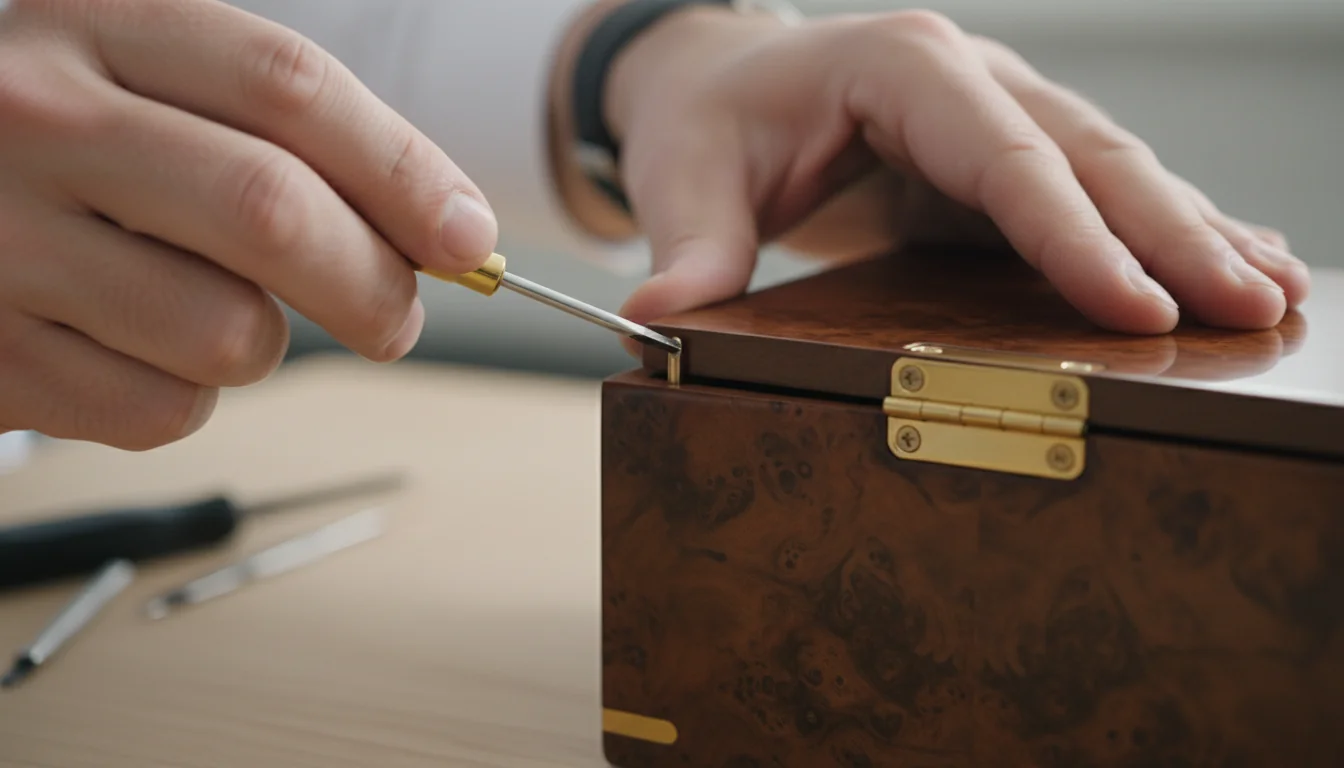
Even perfect pins will feel loose if geometry is off. When mortises are uneven or the stop meets early, the hinge fights the box. Correcting alignment is how you eliminate the last traces of play.
- Shim behind a leaf with 0.1–0.3 mm brass or card to fine-tune angle.
- Relieve a proud mortise lip so the leaf seats fully.
- Check the case stop: if it contacts first, soften or reposition it.
- Use tape as a temporary hinge to test closure before drilling.
Score hinge outlines with a sharp knife first. This prevents fibers lifting that would keep the leaf proud and reintroduce wiggle you thought you eliminated.
If you 3D print prototypes, you’ve seen print-in-place hinges fail when tolerances are “very tight.” The same lesson applies here: clearances must be controlled, not guessed, to remove play precisely.
Micro-shims change lid reveal dramatically. A 0.2 mm shim near the barrel can eliminate visible skew across the full front edge.
Material choices: banish pivot wear
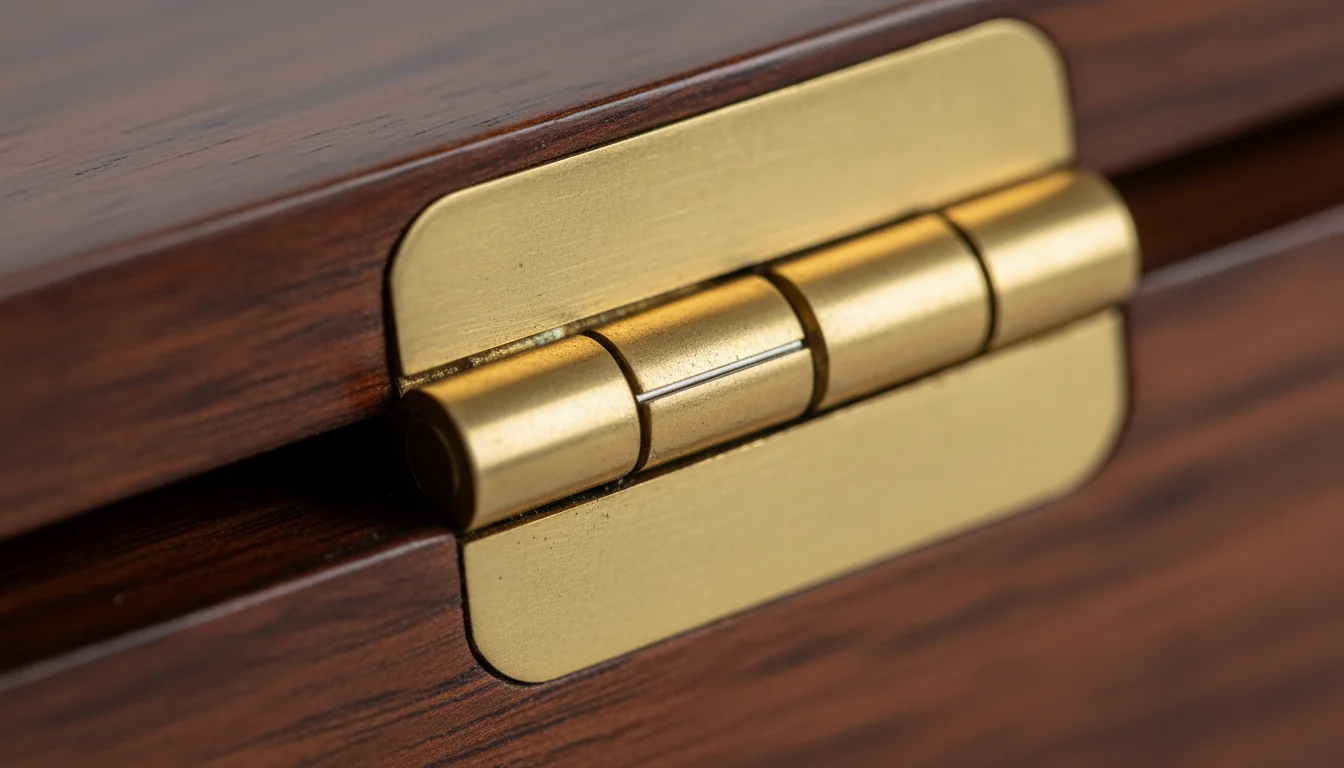
Not all hinges age the same. Brass looks elegant but deforms sooner; stainless resists wear; plated alloys vary. Matching hinge material to box weight and lid size helps you prevent play from returning.
- Light lids: brass or brass-plated is fine if pins are snug.
- Heavier glass lids: choose stainless pins or piano-style hinges.
- Bushings: polymer or brass sleeves greatly extend pivot life.
- Leaf thickness: thinner leaves flex; thicker leaves stay flat under torque.
Avoid mixing soft leaf with a hard pin unless a bushing is present. Mismatched hardness accelerates ovalized knuckles and brings play back fast.
Some craftspeople argue a “little play is helpful.” For watch boxes, silence is the luxury cue. Prioritize materials and bushings that let you eliminate lash while keeping a smooth, feathered close.
Field fixes: eliminate on a budget
You can remove most hinge play with simple supplies. These practical, reversible fixes help you test and tune before committing to a full hardware swap.
- Toothpick + glue thread restore for light-duty holes.
- Business card shim behind leaf to test geometry.
- PTFE tape wrap on a removable pin to trial-fit endplay.
- Low-strength threadlocker (machine screws only) to curb micro-loosening.
Use a torque screwdriver. Set a repeatable 0.08–0.12 N·m so each screw clamps equally. This consistency is a quiet way to eliminate uneven hinge feel.
If the lid includes a dust cover stop, confirm it doesn’t hit first. Adjusting the stop by a fraction of a millimeter can instantly remove the last click you hear at closure.
Step-by-step: how to remove hinge play
- Diagnose: isolate axial vs radial vs screw slack with the hold-and-wiggle test.
- Square it: tape-hinge the lid, mark, and pilot accurately; test with card shims.
- Repair threads: plug or insert, then pre-drive with steel screws.
- Treat the pivot: add micro-washers, re-peen lightly, or replace hinge.
- Torque and verify: set equal torque; close and listen for silence.
A small case is ideal for practice. Try these steps on this compact lacquered single-slot case to perfect your technique before tackling a larger organizer.
Over-tightening. If the leaf bows, you create binding, then loosen to “fix” it—reintroducing play. Flat seating first, torque second.
Why aim to eliminate play entirely?
Because lash grows. Tiny movement hammers screws and knuckles, leading to rapid wear, lid misalignment, and finish damage. Removing it early preserves the mechanism and the box.
Is a little slack acceptable, like in cabinets?
For decorative furniture, some allow minute tolerance. For a watch case, a quiet close is the goal. Target zero-lash rotation to eliminate click and corner lift.
Should I replace or repair the hinge?
Repair threads first. If radial rattle remains, replace the hinge. Worn knuckles rarely hold long. Bushings or new hardware completely remove pivot slack.
What about multi-slot boxes and wider lids?
Wider spans magnify clearance. Reinforce fasteners, add thrust control on both hinges, and square geometry. A refined five-slot organizer like this elegant five-slot casket benefits from matched torque left and right.
Can lubrication eliminate squeaks and clicks?
Lubricants mask noise but don’t cure slack. Use dry PTFE sparingly after you control play. Oils attract dust, which accelerates wear and rattle.
How tight should the screws be?
For tiny screws, 0.05–0.15 N·m is typical. Set a torque driver and stop at snug plus a whisper. Even clamping across all leaves helps eliminate asymmetry.
Any insights from DIY forums or 3D printing?
Forums often note that overly tight tolerances cause binding. On Original Prusa i3 MK3 & MK3S & MK3S+, print-in-place hinges seize if clearances are off. Translate that lesson to wood-and-metal work to eliminate binding and play together.
Eliminating hinge play is a method, not a mystery: diagnose precisely, fix threads, correct geometry, and tune the pivot until the lid glides with silence and certainty.
- Targeted diagnosis beats guesswork; find axial vs radial slack.
- Thread strength and controlled torque stop creep at the source.
- Bushings, shims, and alignment tweaks erase rattle for good.
Practice on a small build, then apply the same Box Hinges Eliminate Play approach to your collection. For single-piece upkeep, pairing a tuned case with a one-watch automatic winder in camphor finish keeps rotation steady without adding hinge wear.
0 comments