


Silica gel keeps moisture in check, but its true value appears when you restore its capacity efficiently. Do you know how to bring saturated beads back to life without damaging them?
In this 2026 guide, you’ll get a clear definition of silica gel as a desiccant, see where reactivation changes the game, and apply validated methods to return beads to service—safely, repeatably, and with less energy. We’ll focus on practical regeneration across home, lab, and compressed air systems.
Moisture control: why reactivation matters
Silica gel is a porous form of silicon dioxide that captures water vapor by adsorption, not absorption. Heat releases the adsorbed moisture, so the same media can be restored and reused many times.
- Extends service life: a single batch can handle many moisture cycles after careful reactivation.
- Stabilizes environments: repeatable drying helps hold tight humidity targets in storage and displays.
- Supports low dew points: renewed media sustains deep drying in adsorption dryers.
- Reduces waste: fewer replacements for sachets, cartridges, or wheel segments.
- Cuts downtime: quick re-drying keeps compressed air systems online.
Typical reactivation targets are around 120 °C so water leaves efficiently without collapsing the pore network.
Because the process is reversible, “uses” and “care” are inseparable: robust use depends on dependable regeneration that preserves capacity and bead integrity.
Thermal methods: safe temperature windows
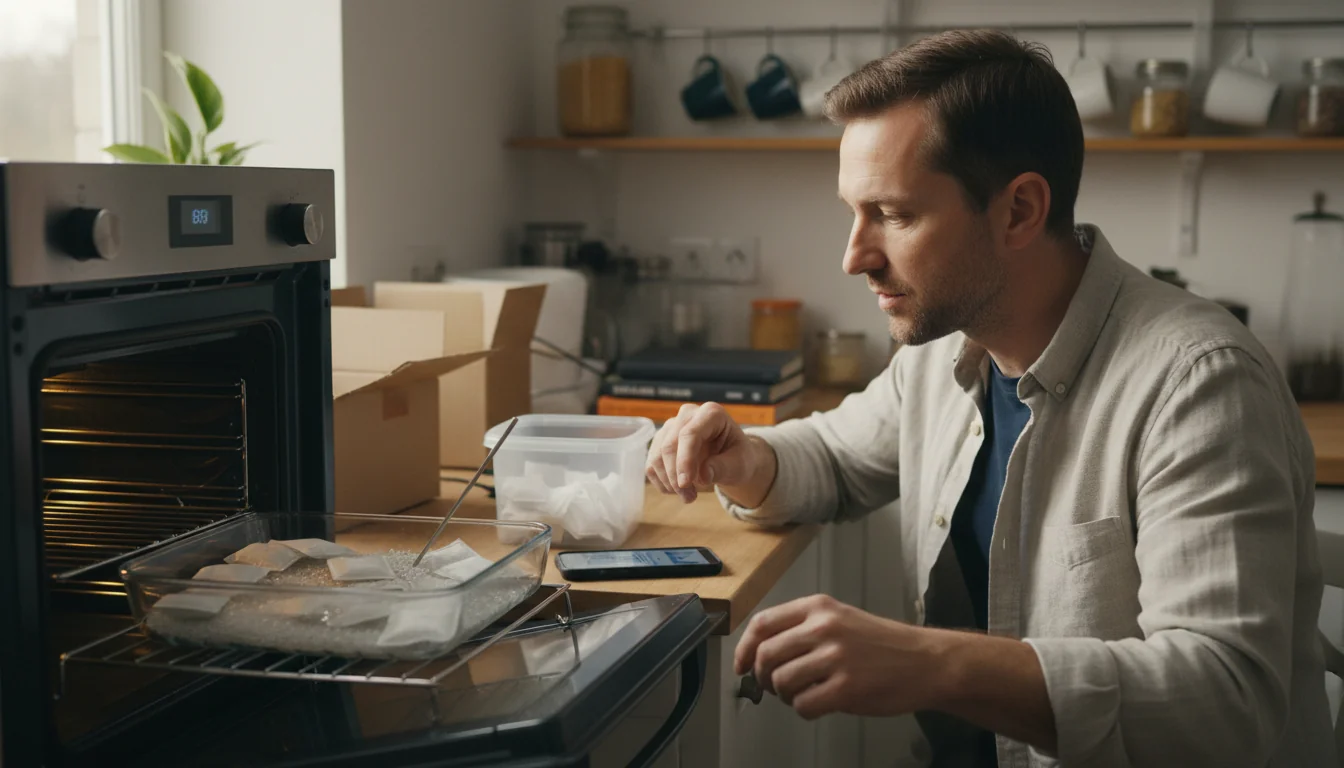
Most users reactivate silica gel by heating. The aim is to desorb water at a temperature that protects structure, coatings, and indicator dyes.
- Convection oven: consistent, even heating for bulk beads and cartridges.
- Microwave: fast but riskier; use short pulses and mix between cycles.
- Heated air stream: ideal for beds and dryers; purge air removes vapor.
- Solar or low-heat plates: slow but gentle for small quantities at Home.
| Method | Typical setting for reactivation |
|---|---|
| Convection oven | 120 °C for 1–2 hours; spread beads thinly for uniform desorption. |
| Microwave | Low power, 1–2 minute pulses; stir between pulses to avoid hotspots. |
| Heated purge air | Warm, dry air through the bed; temperature depends on dryer design. |
| Sun/low heat | Long duration; suitable for small sachets and non-indicating beads. |
Open sachets and remove Tyvek or paper wraps before heating. The casing blocks vapor escape and may deform.
For orange or other indicating beads, stay near 100–110 °C to protect the dye. Higher heat can fade the indicator irreversibly.
Whatever the method, aim for slow, even heating and a clear path for vapor to leave the media.
Compressed air: continuous cycles
In adsorption dryers, regeneration runs in parallel with drying. One tower dries compressed air while the other is restored by purge or heated airflow.
- Heatless purge: a fraction of the dried air expands and strips moisture at ambient temperature.
- Externally heated: purge air is warmed to raise its vapor capacity and accelerate desorption.
- Heated blower: ambient air is heated and blown through the saturated bed; no compressed purge loss.
- Heat of compression/rotary drums: use process heat to restore media with minimal extra energy.
Regeneration air is often heated to around 120 °C. Wheel speed and purge rate shape how fast the desiccant releases bound water molecules.
Position humid exhaust well away from the intake. Recirculating wet air undermines the reactivation phase.
Well-tuned cycles deliver low pressure dew points and steady performance, while conserving energy during the reactivation step.
Quality checks: color and mass
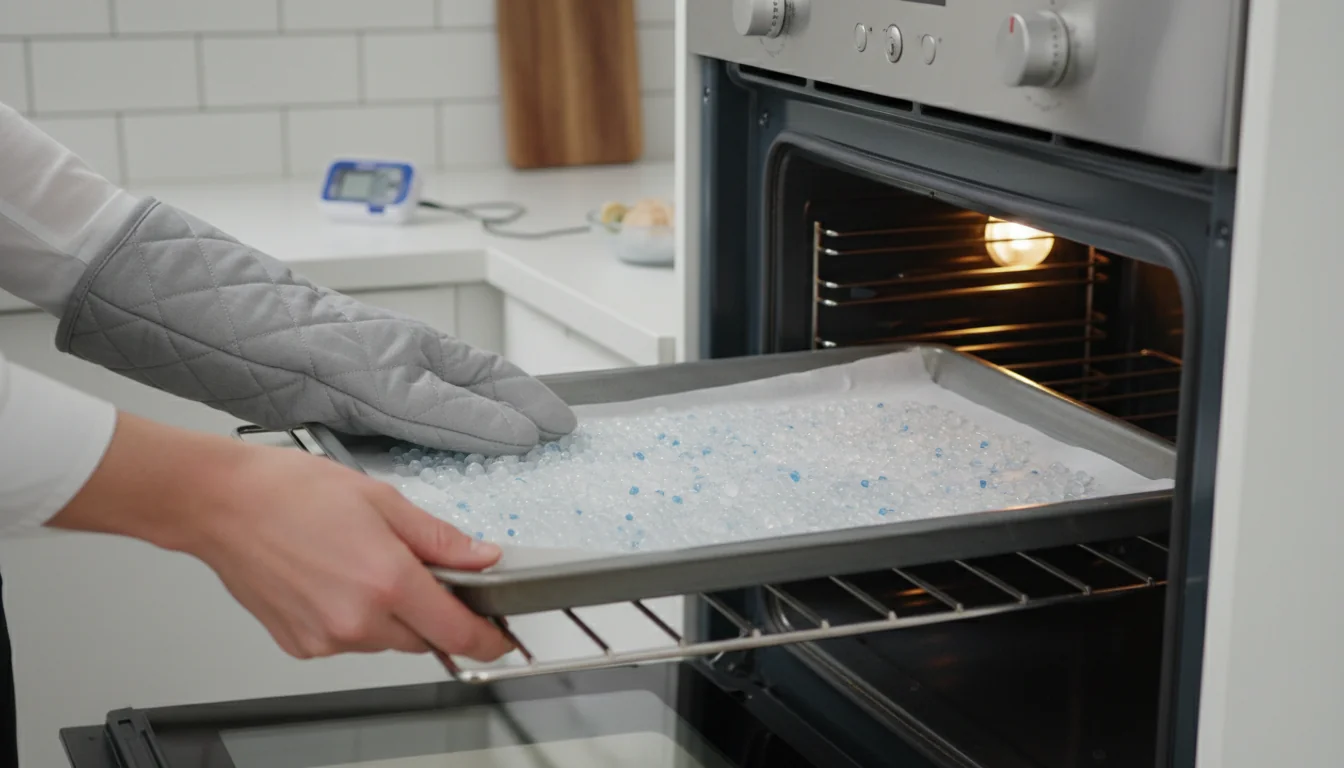
Good regeneration ends when beads return to their “dry” indicator state or to a target weight that reflects low moisture content.
- Indicating beads: confirm original orange or amber tones after heating.
- Non-indicating beads: weigh samples; a steady mass signals dryness.
- Spot test: place a few grams in a sealed jar; fogging suggests residual water.
- Touch and flow: fully restored beads feel hard and flow freely.
Keep a small control jar of freshly reactivated beads. Compare color and mass next time to judge the endpoint quickly.
Many gels can regain a near‑dry state after 1–2 hours at 120 °C; larger beds need more time for core desorption.
Visual cues, a simple scale, and a sealed-jar check keep reactivation consistent from cycle to cycle.
Energy impact: do more with less
Restoring desiccant costs energy. The right strategy trims that demand without compromising dryness targets.
- Use waste heat: capture condenser or process heat for the reactivation stream.
- Recover heat: exchange outgoing humid exhaust with incoming purge air.
- Tune cycle time: avoid over‑drying; stop as soon as mass or color stabilizes.
- Match climate: hotter, drier outdoor air eases desorption; adjust accordingly.
- Optimize wheel speed: enough dwell to release water, not so slow that energy is wasted.
Lower temperatures with longer dwell often preserve capacity better than brief, high‑heat bursts.
Efficient regeneration protects the media and lowers total energy per kilogram of water removed.
In 2026, energy-aware reactivation is a core design choice, not a late tweak.
Material limits: avoid degradation
Repeated heating gradually shifts pore structure and can reduce capacity. Smart handling preserves performance over many cycles.
- Keep liquid water away: soaking and boiling can fracture beads (“popping”).
- Filter upstream: oil and dust foul pores; pre‑filtration extends reactivation value.
- Protect indicators: moderate heat to retain color‑change function.
- Separate from food prep: use dedicated appliances for safety and hygiene.
Some legacy blue indicators contain cobalt salts. Handle dust carefully and choose safer orange formulas when possible.
Shallow layers help desorb uniformly. Thick piles hold steam and overheat locally.
When handled with care, both Type A and Type B silica gels tolerate many restoration cycles before noticeable decline.
Guide 2026: how to regenerate
- Prepare: remove sachets; spread beads 5–10 mm deep on a tray.
- Heat: set oven to 120 °C; run for 1–2 hours.
- Vent: allow moist air to escape; avoid sealed ovens without exhaust.
- Cool: let beads reach room temperature in a dry container.
- Verify: check color or weigh; reseal promptly to prevent re‑adsorption.
If using a microwave, run 1–2 minute pulses at low power, stirring between cycles to avoid hotspots.
Do not regenerate beads inside sealed Tyvek sachets; vapor pressure can rupture the wrap.
Why restore silica gel instead of replacing it?
Reactivation preserves adsorption capacity, reduces waste, and keeps drying systems available. It’s fast, repeatable, and supports consistent humidity control across many cycles.
How does reactivation compare to using new material?
Fresh beads may offer slightly higher capacity, but proper regeneration restores most performance. In continuous dryers, cycling beds is essential for uninterrupted service.
What’s the safest temperature for routine re-drying?
120 °C is a widely used setpoint for 1–2 hours. For indicating beads, 100–110 °C helps protect dyes during repeated cycles.
Can I regenerate in a microwave?
Yes, but use low power and short pulses. Stir often and stop once color or mass stabilizes. Avoid metal, thick piles, and sealed sachets to prevent overheating.
How do dual-tower dryers handle restoration?
They switch towers. One adsorbs moisture while the other is restored by purge or heated air. Wheel speed and purge settings govern cycle efficiency.
How often should I re-dry sachets at Home?
Regenerate when color changes or weight increases. In humid seasons, smaller packs may need attention every few weeks; larger packs last longer between cycles.
Is molecular sieve a better choice for reuse?
It reaches lower dew points but often needs higher reactivation energy. Silica gel balances easy restoration, cost, and broad humidity control.
Where can I learn about compressed air re-drying?
Search “Understanding Compressed Air Systems and the Role of Regenerative Desiccant Air Dryers” for clear overviews of cycle control and purge strategies.
Restoring silica gel is a controlled desorption step that keeps this desiccant effective, economical, and reliable across many use cases.
- Target even heating—about 120 °C—and shallow layers.
- Verify endpoints by color, mass, and flow behavior.
- Optimize airflow, cycle time, and waste‑heat use to save energy.
Apply these steps in 2026 to extend media life, stabilize humidity, and run drying systems with confidence.
0 comments