


Preparing a watch winder before a 2-week absence is simple—if you focus on the few settings and checks that matter. Two weeks is long enough for calendars to drift, yet short enough to avoid full servicing concerns.
Going away soon? In this 2026 field-tested guide, you’ll learn what to do with different watch types, how to set turn counts without stress, and where to place your winder so it runs safely in your absence.
Risk check: movements and dates
Two weeks away magnifies small risks: date drives engaged overnight, excessive turns per day, or poor placement. Start by matching your plan to your movement and complication set.
- Time-only automatic: Either let it stop or set a conservative TPD; both are fine for a short leave.
- Day-date, triple calendar, moonphase: Consider keeping it running to avoid complex re-setting on return.
- Micro-rotor or unidirectional wind: Verify winding direction; wrong direction means zero effect during your absence.
- Hand-wound: No winder needed; store crown-side up and wind when you’re back.
- Vintage pieces: If service history is unknown, favor rest over continuous running while you’re away.
Avoid setting the date between roughly 8 p.m. and 4 a.m. The date mechanism may be engaged. If you return late, wait until morning before adjusting.
If you’re unsure of the direction or TPD, start modestly. You can increase turns later; overshooting at the outset isn’t necessary for a two-week gap.
Programming: two-week settings
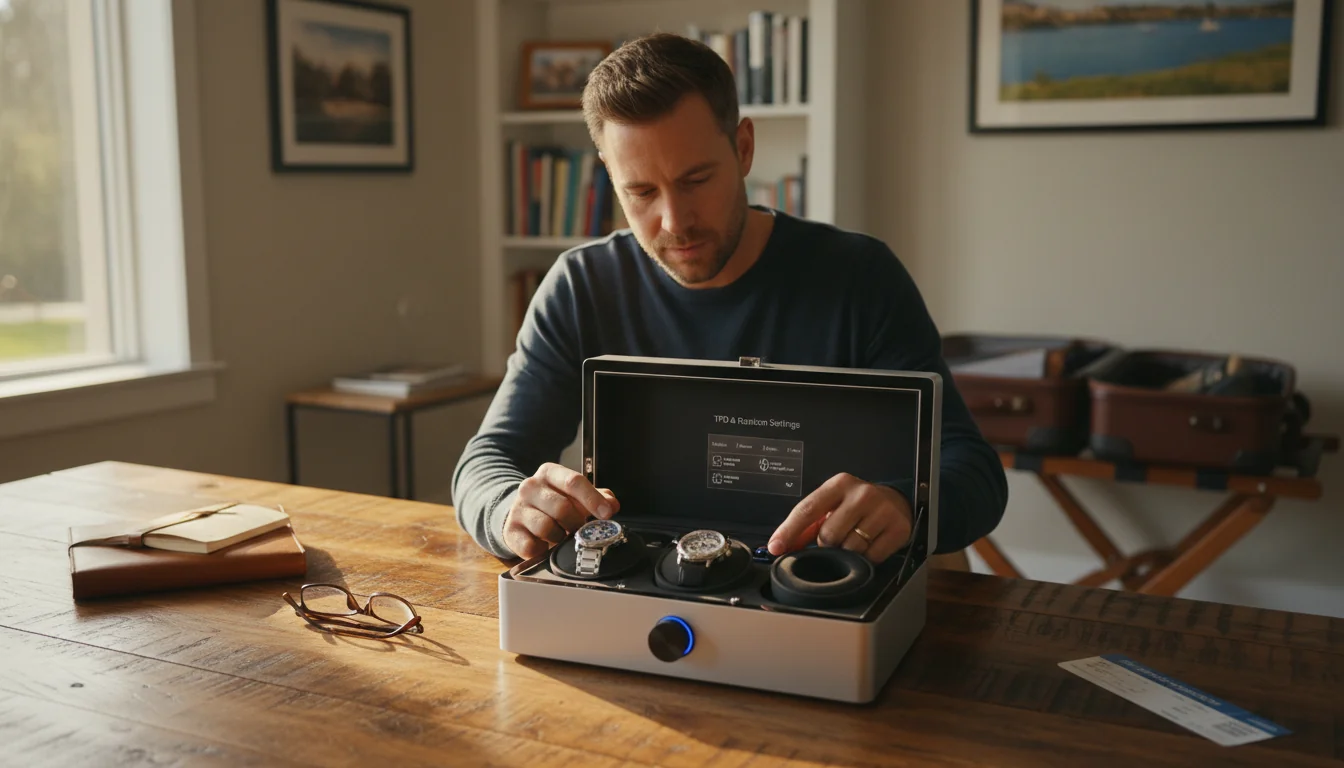
For a short leave, your aim is stability, not maximum charge. Program direction and turns to match the movement, and add regular rest windows.
- Direction: Bidirectional is safest if available; otherwise, set CW or CCW per your caliber’s needs.
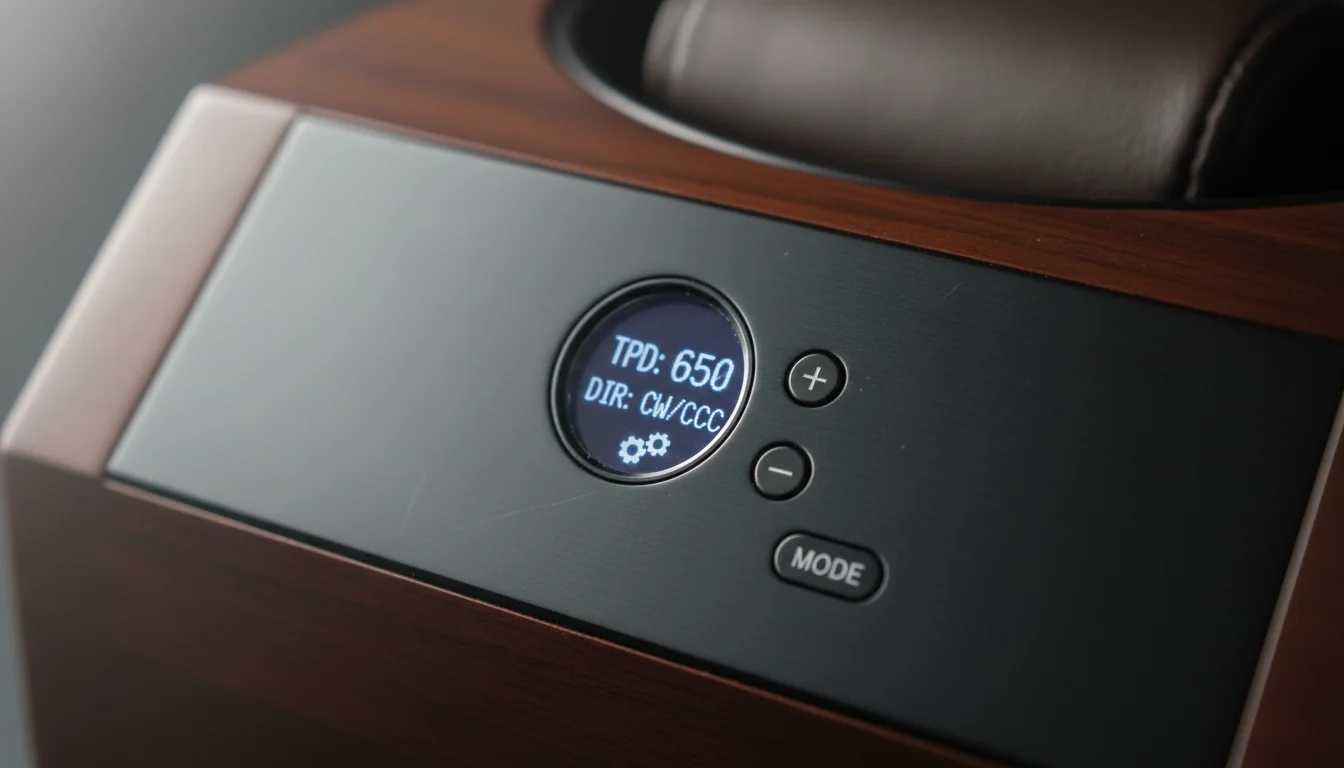
- TPD baseline: Start at 650–800 TPD for many modern automatics; time-only can go lower.
- Duty cycle: Use intervals (e.g., 15 minutes on / 45 minutes off) to mimic wear and limit unnecessary motion.
- Night pause: Add a quiet period during typical sleep hours to reduce mechanical fatigue and noise at home.
- Test run: Before the absence, run 24 hours and confirm the power reserve is stable and timekeeping unchanged.
A slipping bridle in most automatics prevents true “overwinding.” The real risk in your absence is excess motion causing needless wear—hence modest TPD.
If your watch has a lengthy power reserve, even lower TPD or alternating-day operation can maintain it over two weeks away.
Power and placement: safe while away
Most problems during an absence come from where the winder sits and how it’s powered. Control heat, dust, magnetism, vibration, and power events.
- Stable surface: Avoid rattly shelves; vibration can amplify noise and loosen fasteners over time.
- Low heat and light: Keep out of direct sun and away from radiators; higher temps thin oils.
- Magnetism: Distance from speakers, induction chargers, or strong closures; magnetization disturbs timekeeping.
- Power backup: Use a surge protector; consider battery mode if outages are common.
- Dust control: Close the cover; add a small desiccant pouch if your home is humid.
For lighter, dust-resistant housings that suit shelving in your absence, explore our acrylic-focused selection as an alternative to heavy cabinetry.
A smart plug can add timed pauses or let a house-sitter stop the winder at night—useful if walls are thin and noise carries before bedtime.
Run or rest: choosing for 14 days
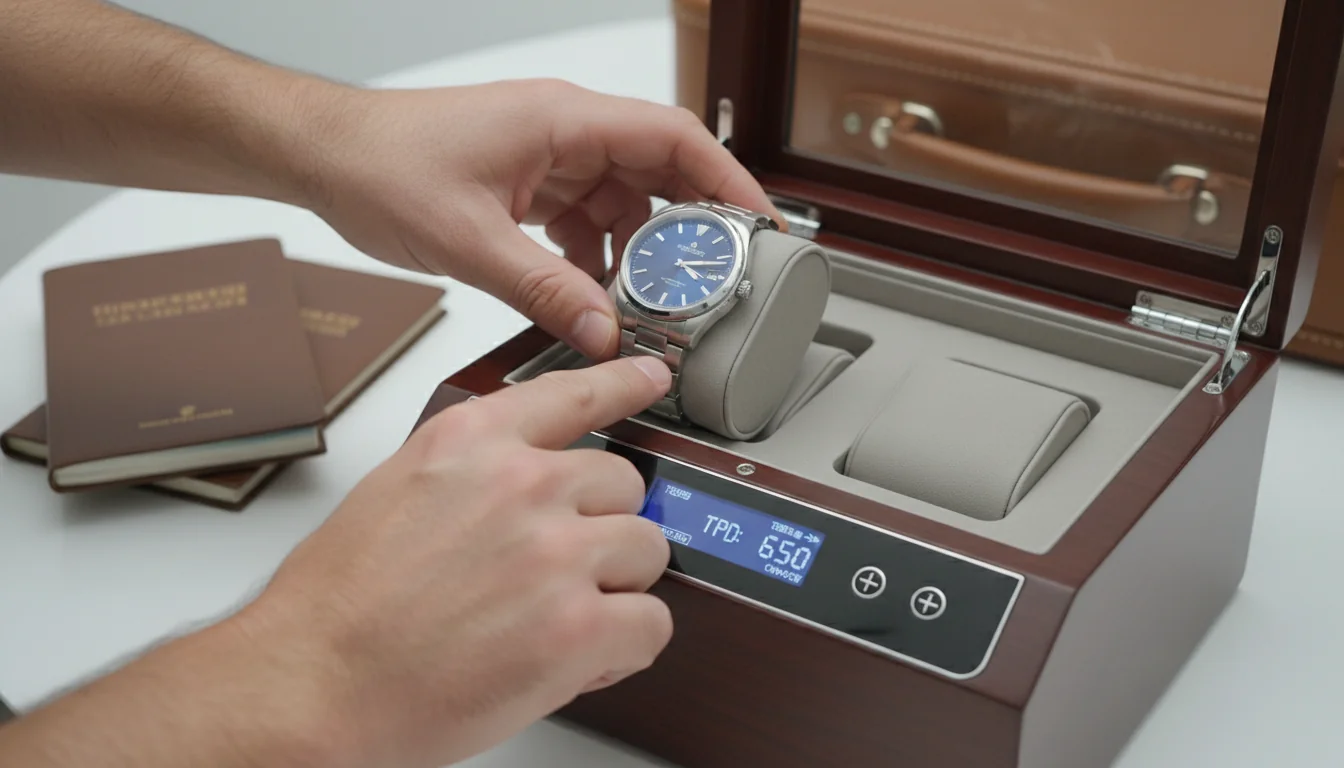
For a two-week leave, both options—keep running or let it stop—can be right. Choose based on your complications and how confident you are resetting them after your absence.
| Watch scenario | Two-week plan |
|---|---|
| Time-only, serviced recently | Let it rest. Store safely and wind on return. |
| Day-date worn often post-trip | Low TPD with night pause; quick start on return. |
| Moonphase/annual calendar | Keep running with conservative TPD and rest cycles. |
| Unknown service history | Favor rest; avoid continuous motion in your absence. |
If you let a complex calendar stop, allocate 10–15 quiet minutes to reset when you’re back. Never force quickset functions during the danger window.
Short absences rarely impact lubrication. The decision is about convenience, calendar integrity, and risk tolerance—not oil health over two weeks.
Quiet, timers, and checks
Absence planning includes noise control, timer logic, and a last sweep for household safety. You want your home as calm as your watches while you’re away.
- Noise: Place on a soft pad; many winders run under ~20–30 dB, but furniture can amplify hum.
- Smart pause: Program a night stop; it reduces cycles and avoids running when no one’s around.
- Power audit: Single surge protector; avoid daisy chains. Test a brief outage to see how your winder recovers hours later.
- House-sitter brief: Explain the winder is intentional; they only need to watch for unusual noise or flashing indicators.
- Fire safety: Ensure clear airflow; disconnect nonessential devices before you leave.
A timer-based “week and weekend” schedule works well for a two-week gap—regular motion on weekdays, longer rests on Sundays.
If in doubt, shorten active windows. For a short leave, less motion is usually more prudent than more.
Backup plan if you skip winding
You can ignore the winder entirely for a two-week absence and still return smoothly—if you store and reset efficiently.
- Storage: Case closed, crown protected, away from speakers and direct light; add a small silica pouch.
- Restart: On return, wind slowly—about 20–30 crown turns—then set time and date safely.
- Fast set routine: Move hands to 6:30 to ensure the date train is disengaged, adjust date, then set time.
- Multiple watches: Prioritize the one you’ll wear first; stagger the rest over the next day or two.
- Final check: After a day on the wrist, confirm accuracy; minor drift after rest is normal.
If you’re unsure about quickset rules, set the time only and wear it for a day. Adjust the date the next morning to avoid risk after your absence.
This fallback is ideal for vintage or minimally serviced pieces where continuous motion in your absence isn’t desirable.
How to prepare it in 5 quick steps
- Identify your watch type and complications; decide run vs. rest for your two-week leave.
- Set direction and TPD (e.g., 650–800) with a night pause to reduce wear in your absence.
- Place the winder on a stable, cool surface; keep distance from speakers and chargers.
- Power through a surge protector; test a brief outage and confirm recovery behavior.
- Run a 24-hour test before leaving; verify timekeeping and quiet operation.
Do not boost TPD “just in case.” For a short absence, restraint protects the movement and keeps noise low.
Prefer a compact, single-slot option with a calm duty cycle? Consider a quiet single-winder with timed rests to keep things simple while you’re away.
Should I keep every watch running during a short trip?
Not necessarily. Time-only models can rest safely. Keep complex calendars running if you dislike resets. For a two-week absence, convenience and safe handling matter more than oil health.
What are safe TPD and direction choices for a two-week gap?
Start around 650–800 TPD with bidirectional motion and a night pause. Unsure? Try a single-winder offering flexible direction and adjust after a 24-hour test.
Can a winder overwind my watch while I’m away?
Most automatics have a slipping bridle, so true overwinding won’t occur. Excessive TPD can still cause needless wear. Choose a model with balanced intervals to keep motion modest in your absence.
What if there’s a power cut while I’m gone?
Use a surge protector and, if possible, battery mode. After an outage, many winders resume the program. It’s fine if a time-only piece stops; reset calmly when you return from your absence.
Is it risky to set the date after I get back late at night?
Yes—avoid the danger window around 8 p.m.–4 a.m. If resetting on return, move hands to about 6:30 first, or wait until morning. A winder with a night pause helps reduce engagement conflicts.
Where should I place the winder during my leave?
Cool, stable, and away from speakers and bright sun. Keep the cover closed. If humidity is high during your absence, add a small desiccant and avoid heat sources.
How loud is acceptable if someone house-sits?
Aim for a soft hum under roughly 30 dB. To minimize audible cycles at night in your absence, choose timed pauses or a unit with a gentle, quiet cycle.
For a two-week absence, prioritize safe settings, smart placement, and calm routines; perfection isn’t required for such a short window.
- Match TPD and direction to your movement, then add a night pause.
- Keep the winder cool, stable, and away from magnets and heat.
- Let time-only pieces rest; keep complex calendars running if you prefer.
If you also want a low-key option for trips, a compact single-slot design with gentle intervals can maintain peace of mind while you’re away.
0 comments