


What exactly is FKM, and how is it different from standard rubber you meet in everyday seals and O‑rings? If you work with gaskets, hoses, or watch straps, this question matters.
In this 2026 guide, you’ll get a precise definition of FKM, the standards behind its name, and a practical comparison with common rubber families. Expect clear tables, selection tips, and failure‑avoidance advice.
Rubber defined: FKM under standards
FKM is the short form used in the American nomenclature for a fluorocarbon‑based fluoroelastomer family. It is the term defined by ASTM D1418, while FPM is the equivalent abbreviation in ISO contexts.
- Definition: FKM = fluorocarbon fluoroelastomer per ASTM D1418; FPM is the ISO designation.
- Composition: high‑fluorine polymers built on vinylidene fluoride (VDF) with co‑monomers like HFP and TFE.
- Classification: copolymers, terpolymers, and specialty grades with tailored fluorine content.
- Naming context: ASTM uses the FKM letter code; ISO uses FPM; both point to fluoro‑rubber.
- Scope: seals, O‑rings, gaskets, hoses, watch straps, and high‑duty process equipment.
ASTM D2000 often tags fluoroelastomers as “HK,” signaling very high heat resistance and low swell versus typical rubber types.
When people ask, “What is FKM rubber?” this is the precise, standards‑based answer. From here, differences with standard elastomers become clear.
Rubber performance: heat and chemicals
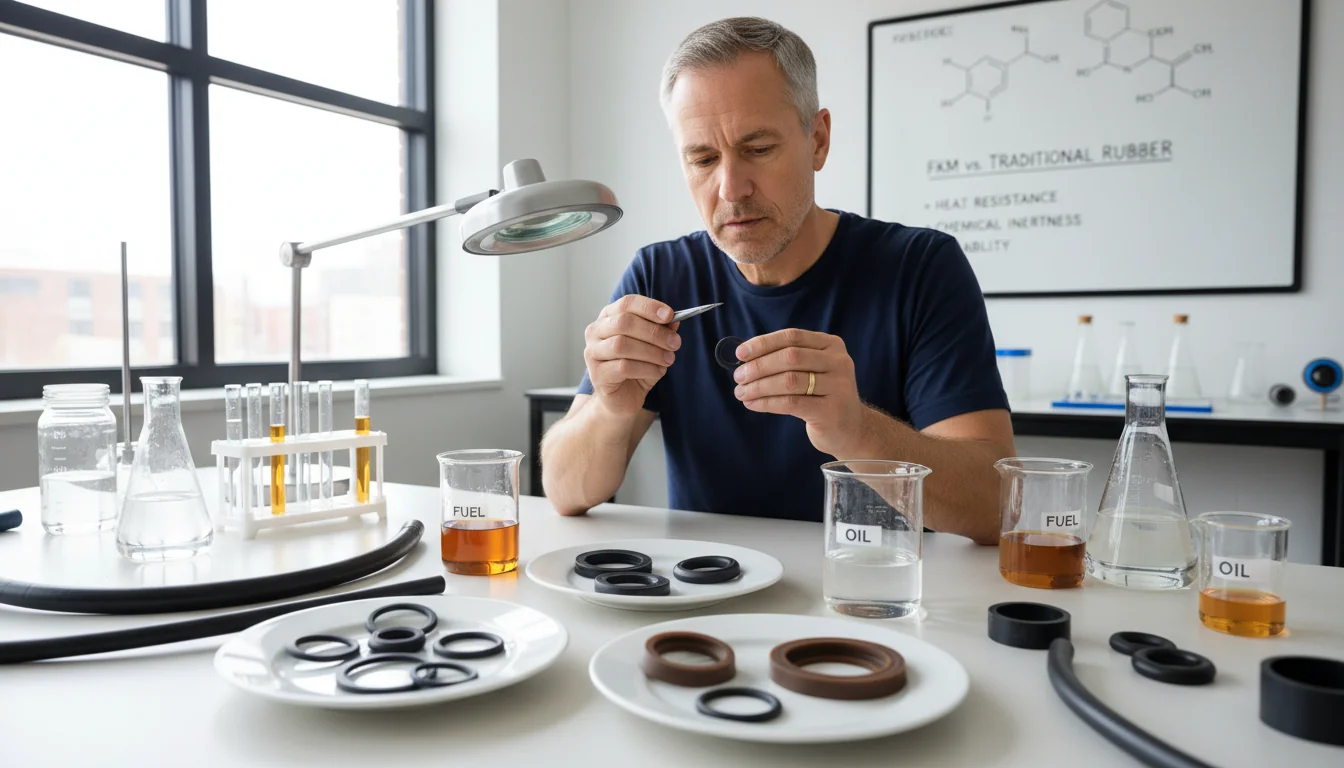
FKM stands out by tolerating heat and aggressive media far beyond standard rubber families such as nitrile (NBR), EPDM, or general silicone. That contrast drives most selection decisions.
- Heat capability: typically −20°C to +200°C; specialty grades reach higher; brief peaks above this are application‑dependent.
- Chemical resistance: excellent in oils, fuels, hydrocarbons, many solvents; poor in ketones, esters, amines, some organic acids.
- Permeation: low gas permeability compared with common rubber, useful for vacuum and pressure systems.
- Density: around 1.8 g/cm³, much higher than mainstream elastomers, aiding quick identification.
- Compression set: engineered compounds can hold seals under sustained heat better than standard choices.
| Property | FKM vs. standard rubber |
|---|---|
| Heat resistance | Higher than NBR, EPDM, and general silicone in continuous duty |
| Fuel/oil compatibility | Excellent vs. swelling/degradation seen in many standard elastomers |
| Steam/hot water | Application‑specific; not as robust as EPDM in superheated steam |
| Low‑temp flexibility | Weaker than silicone and specialty EPDM; improved in certain FKM grades |
Avoid FKM in systems rich in ketones, esters, high‑pH amines, and superheated steam. These media drive excessive swell or rapid aging in fluoro‑rubber.
This performance profile explains why FKM O‑rings outlast standard rubber in fuel, oil, and solvent exposure—while EPDM or silicone still win in steam or ultra‑cold service.
Rubber chemistry: types and cures
Different FKM backbones and cure systems explain why two fluoro‑rubber compounds can behave so differently in the same fluid or temperature window.
- Backbones: copolymers (VDF/HFP), terpolymers (VDF/HFP/TFE), and ether‑modified variants for lower glass transition.
- Fluorine content: generally 66–70%; higher fluorine elevates chemical resistance but hurts cold flexibility.
- Cure systems: bisphenolic (ionic), diamine, or peroxide cross‑linking; each shifts heat, hydrolysis, and demolding behavior.
- Low‑temp focus: PMVE or ethylene‑containing grades can lower the glass transition for better sealing below −20°C.
- Processing: compounding fillers and plasticizers fine‑tune compression set and mold release.
| Cure system | Strengths in rubber parts |
|---|---|
| Bisphenolic (ionic) | Superior heat aging and compression set; common for seals and O‑rings |
| Diamine | Good rubber‑to‑metal bonding; less used due to water sensitivity |
| Peroxide | Better in hot aqueous and electrolyte media; slightly lower thermal stability |
When fluid is hot water or electrolyte, shortlist peroxide‑cured FKM. In dry heat and hydrocarbons, bisphenolic cures usually deliver the best retention.
Knowing both backbone and cure lets you predict swelling, sealing at low temperature, and service life more reliably than a generic “FKM” label.
Rubber in service: seals that last
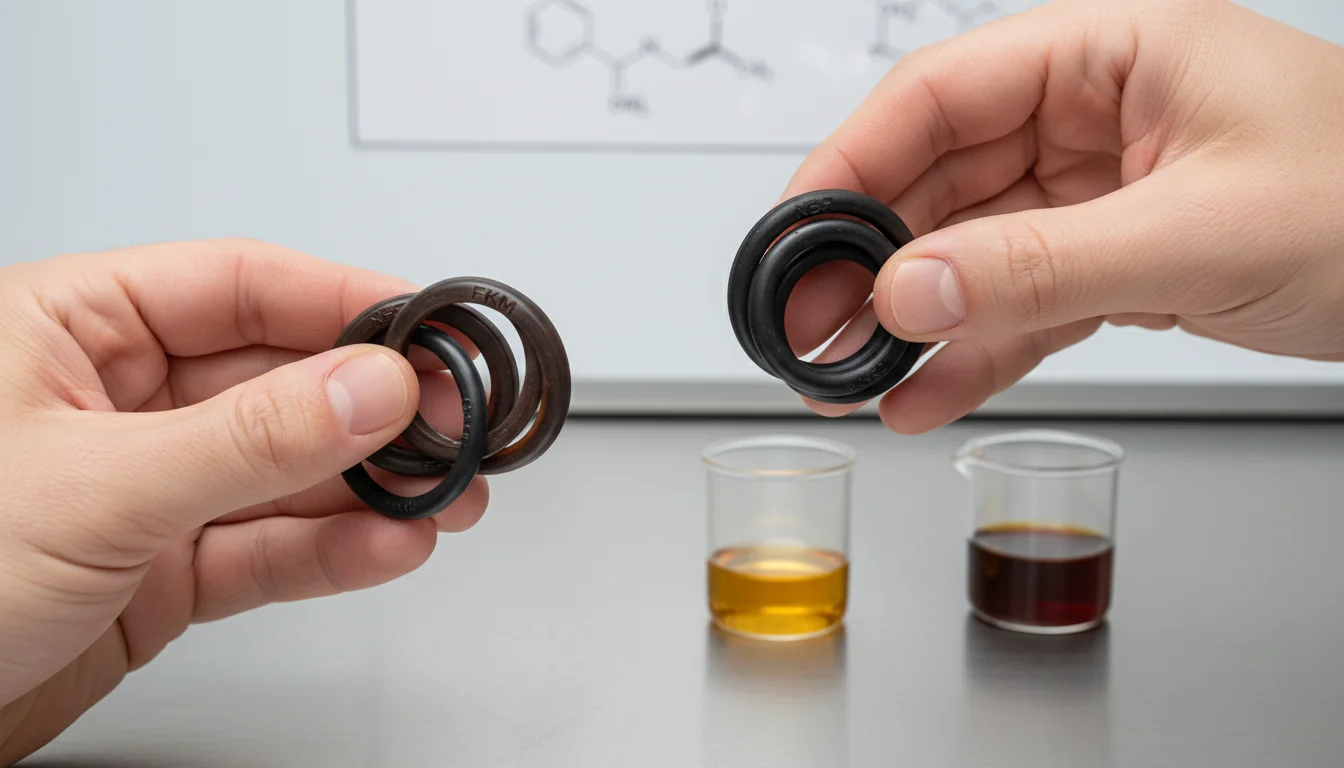
Where standard rubber fails, FKM earns its keep: in engines, refineries, chemical skids, and even wearable accessories that face sweat, UV, and oils.
- O‑rings and gaskets: long‑life sealing against fuels, oils, aromatic hydrocarbons, and many solvents.
- Radial shaft seals: stability at high surface speed and temperature where NBR hardens quickly.
- Process equipment: pumps, valves, couplings in chemical processing, oil and gas, and aerospace.
- Food/pharma variants: select compounds meeting FDA 21 CFR 177.2600, USP Class VI, or 3‑A sanitary needs.
- Watch straps: durable, low‑stain, and UV‑resistant bands compared to common silicone blends.
Regulatory rubber grades trade absolute chemical breadth for compliance. Verify media lists even for “food‑grade” FKM before service.
If your Home team is mapping a Rubber Materials Overview or a “What we do” memo, put FKM in the TOP tier whenever oils, fuels, or aggressive solvents dominate.
Rubber choices: FKM vs others
Selecting the right elastomer means weighing chemistry, temperature, and cost. Here’s how FKM stacks up against common alternatives.
- NBR (nitrile): good for oils; weaker in heat and fuels with high aromatics or oxygenates.
- EPDM: excellent for steam and hot water; poor in hydrocarbons and fuels.
- Silicone: outstanding low‑temperature flexibility; limited in fuels and many oils.
- FEPM: enhanced base resistance; used when caustics challenge standard fluoro‑rubber.
- FFKM: near‑universal chemical resistance; chosen for extreme heat and harsh chemistries.
| Elastomer | Best use vs FKM |
|---|---|
| NBR | Lower‑cost oil sealing at moderate heat; FKM wins at higher heat/solvents |
| EPDM | Steam/hot water champions; FKM superior in fuels/hydrocarbons |
| Silicone | Cold‑flexibility and biocompatibility; FKM for chemical/oil exposure |
| FEPM | Better in strong bases; FKM broader in fuels and many solvents |
| FFKM | Maximum chemical/thermal range; far higher cost than FKM |
If fuel, oil, or solvents dominate, start with FKM. If steam or caustic CIP rules, shortlist EPDM or FEPM; go FFKM only for extremes.
This trade‑off view helps specify the right product without costly over‑engineering or premature seal failure.
Rubber standards: test and classify
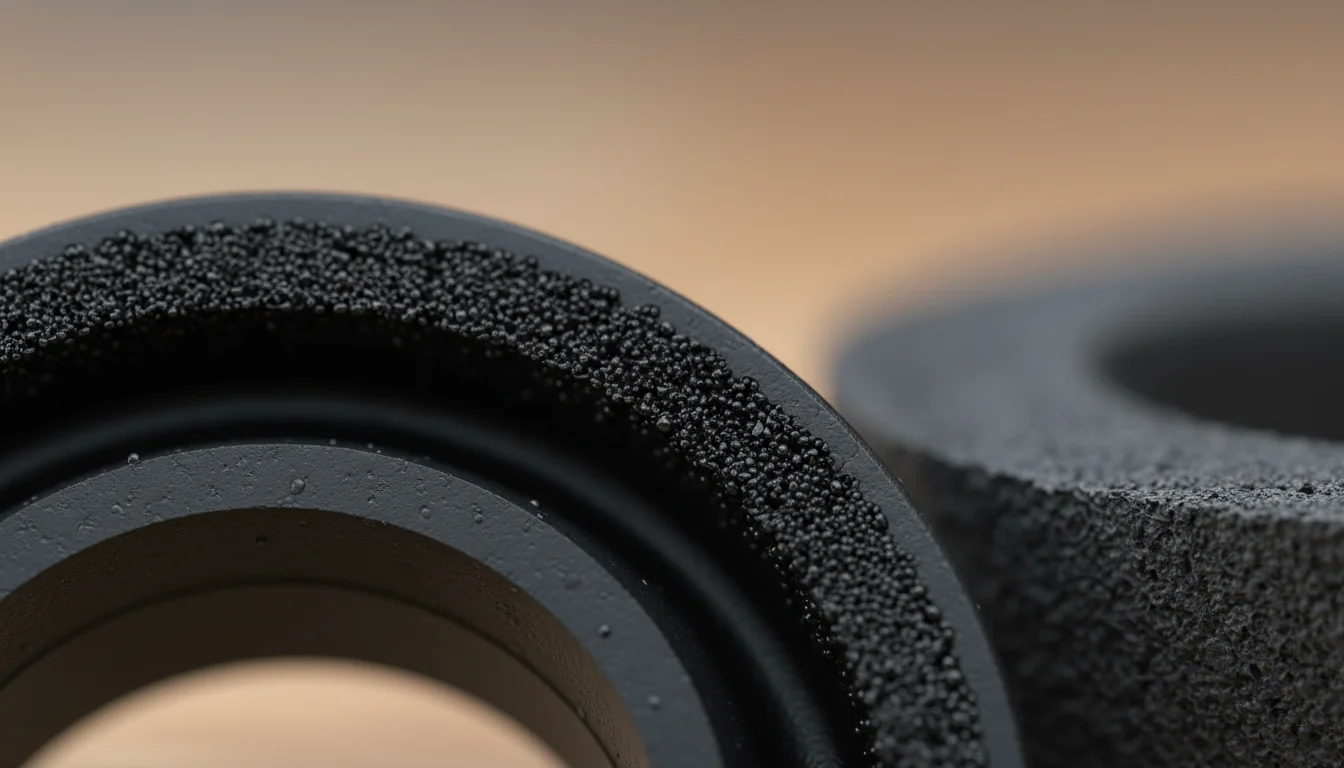
Understanding how rubber is named and tested keeps teams aligned from design to QA. FKM is well covered by international practice.
- ASTM D1418: letter codes for elastomers; FKM = fluoroelastomer; FPM is the ISO counterpart.
- ASTM D2000: callouts like “HK” indicate high heat/low swell class for fluoro‑rubber parts.
- Hardness ranges: 60–90 Shore A are common for O‑rings and gaskets.
- Volume swell tests: compare immersion change in oils, fuels, or solvents vs standard rubber.
- Glass transition (Tg): low‑temperature sealing depends on Tg and compound plasticization.
Don’t assume two FKM compounds behave identically. Verify test reports and media compatibility for the exact grade and cure system.
Clear standards keep a Rubber Materials Overview consistent, whether you’re drafting a Product spec or reviewing supplier datasheets.
How to specify FKM rubber: a quick guide
- Define media and temperature: list fuels, oils, solvents, steam, and extremes.
- Choose backbone and cure: match copolymer/terpolymer and bisphenolic vs peroxide.
- Set hardness and tolerance: pick Shore A and sizing for O‑rings or gaskets.
- Check compliance: FDA, USP Class VI, or sanitary needs for process uses.
- Validate with tests: volume swell, compression set, and thermal aging on samples.
For mixed exposure, create a worst‑case media matrix and screen 2–3 FKM grades before locking a final seal compound.
What does FKM mean in rubber?
It’s the ASTM D1418 code for a fluorocarbon fluoroelastomer. ISO often uses FPM, but both refer to the same fluoro‑rubber family.
Why pick FKM over standard rubber?
Superior resistance to fuels, oils, and many solvents, plus higher heat stability. It outlasts NBR or general silicone in hydrocarbon exposure.
Is FKM the same as FPM?
Practically yes: FKM is the ASTM short form; FPM is the ISO short form. Both indicate fluoro‑rubber with high fluorine content.
When is FKM a bad fit?
In superheated steam, ketones, esters, strong amines, or hot caustics. Consider EPDM, FEPM, or FFKM instead, based on the media.
What about food or pharma uses?
Pick compounds with FDA or USP Class VI approvals. Verify cleaning agents; caustic CIP can challenge some grades.
How does FKM compare to FFKM?
FFKM has broader chemical and heat resistance but is much costlier. FKM is the workhorse for oils and fuels at moderate to high heat.
Can FKM handle low temperatures?
Standard grades seal down to about −20°C. Specialty fluoro‑rubber types push lower by adjusting backbone and plasticization.
In short, FKM is a standards‑defined fluoro‑rubber that outperforms standard elastomers in heat and hydrocarbon media while trading off steam and extreme cold.
- Know the code: FKM (ASTM) vs FPM (ISO) are the same family.
- Match the media: fuels/oils favor FKM; steam favors EPDM.
- Specify smartly: backbone, cure, and approvals decide success.
Apply these 2026 guidelines to choose the right rubber first time and prevent avoidable seal failures.
0 comments