


A watch winder can be a joy on the nightstand—until a faint hum or glowing LED spoils your sleep. If you keep automatic watches near your bed, the bedroom changes what “good” looks like.
This 2026 guide to 7 silent watch winders for the bedroom shows how to evaluate noise, light, footprint, schedules, and safety—so your sleeping space stays calm while your timepieces stay ready.
Night-time quiet: measurable silence
In a quiet room, even a soft whirr can feel loud. Aim for near‑silent operation measured in decibels, plus features that damp vibration on a dresser or bedside table.
- Below 25 dB claimed noise level for true bedroom use; lower is better by the pillow.
- Soft isolation: anti‑vibration feet, cushioned motor mounts, and a decoupled gear train.
- Brushless, premium Japanese motor architecture for low noise and long life.
- Dense case materials (wood or composite) with felt lining to absorb resonance.
- Configurable TPD: 650–900 with CW/CCW/alternating to match automatic movements.
Place the winder on a solid, heavy surface. A light, hollow nightstand amplifies noise more than a sturdy dresser.
If you share a room, prioritize a unit with a genuine “quiet cycle.” It reduces runs at night or pauses entirely during your sleep window.
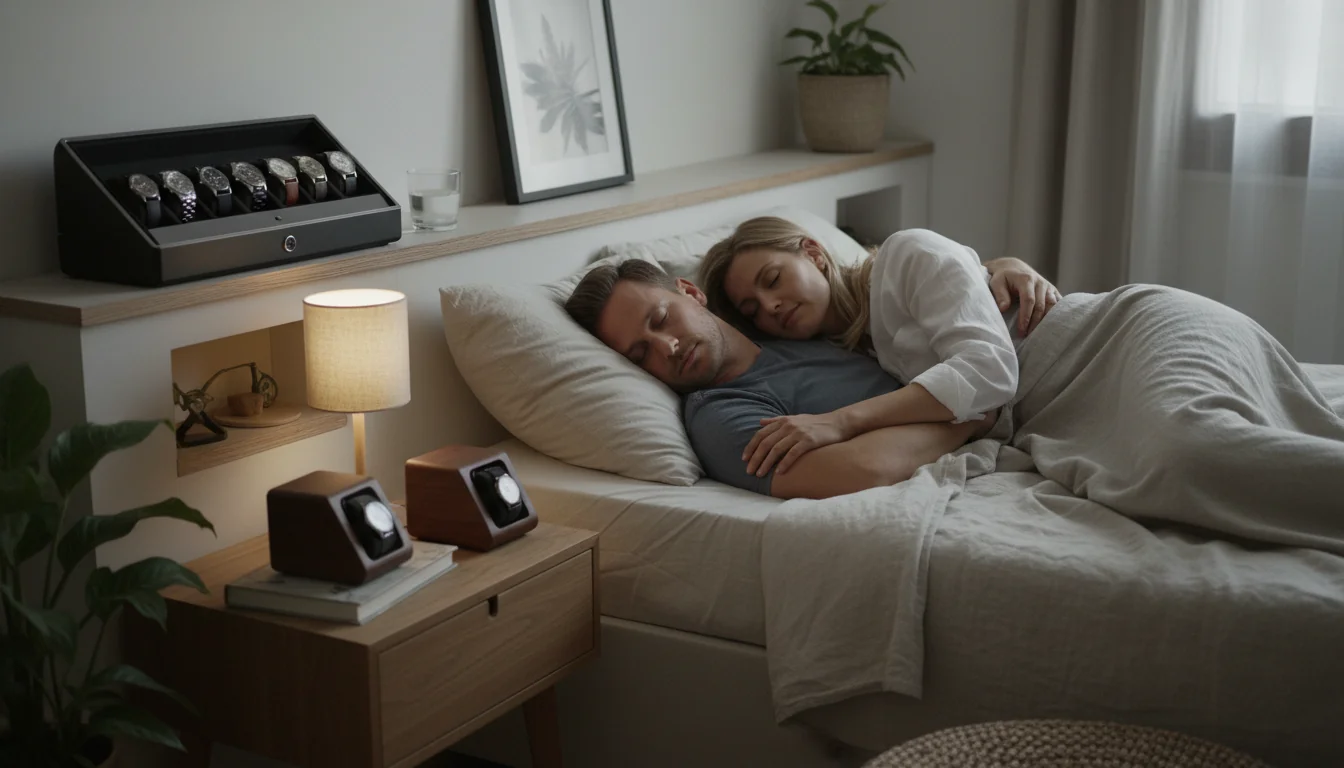
Light discipline: darkness preserved
Blue LEDs look great in a study, not at 2 a.m. Bedside winders need strict light control to keep your sleep space dark and calm.
- No LED glow in operation or an option to disable all lighting.
- Memory of last setting so lights stay off after power cycles.
- Tinted window or solid door to block any indicators inside.
- Lid‑open pause to stop rotation instantly when you access a watch at night.
- No blinking status lights; silent, display‑free designs are ideal near the bed.
Even a tiny LED can feel bright at night. If a unit has non‑defeatable lights, it’s better suited to a dressing room than a nightstand.
In user reports, the best bedroom units look like display boxes by day and vanish into darkness after lights‑out.
Bedside footprint: compact and stable
Nothing should rattle or dominate a small room. The right winder fits your furniture and resists micro‑vibrations that travel through a nightstand.
- Single or dual modules under 18–20 cm wide for tight nightstands.
- Low center of gravity and anti‑tip base for safe bedside access.
- Rear vents with 5–8 cm clearance so motors stay cool and quiet.
- Felt or rubber base to prevent buzz against wood tops.
- Soft pillows accommodating bracelets from ~16 to ~21 cm without squeak.
Moving a winder from the headboard side to a dresser 2–3 meters away can reduce perceived noise by 3–6 dB at the pillow.
For small primary suites, a modular single unit is often calmer than a bulky quad on the nightstand.

Safe storage: security by the bed
A sleeping area is high‑traffic for kids and pets. Safety features matter when watches live within arm’s reach of the pillow.
- Lockable door or clasp to prevent curious hands opening the case.
- Soft linings and firm pillows that hold the watch without compression marks.
- Non‑magnetic construction; avoid strong magnets near mechanical watches.
- Ventilation plus a small desiccant pack to stabilize humidity around the bed.
- Stable cable routing: no dangling cords where feet or vacuum cleaners catch.
If your nightstand wobbles, add a thin anti‑vibration mat. It protects wood and cuts structure‑borne noise.
For guest rooms, choose a calm, understated exterior that blends with quiet décor and doesn’t advertise valuables.
Power and cycles: aligned to sleep
Bedrooms benefit from time‑aware programs. The right schedule keeps automatics wound without disturbing your rest.
- 12‑hour night pause or “quiet cycle” that suspends motion while you sleep.
- Start delay to avoid runs right after lights‑out; set a first cycle for morning.
- Battery mode for shelves without outlets; AC for long continuous use.
- Directional control: CW, CCW, or alternating for mixed collections.
- TPD presets around 650–900 cover most modern automatics without overwind.
If your schedule shifts, program the “on” window for your waking hours. The room stays quiet at night and finishes a cycle before you get dressed.
A well‑tuned overnight pause mimics wearing patterns and preserves a tranquil sleeping zone.

Seven night‑proof picks: archetypes
Below are seven silent winder archetypes that consistently suit bedrooms. Choose the profile that fits your furniture and sleep habits.
- Compact single, quiet cycle: Small footprint for a tight nightstand; sub‑25 dB brushless motor with 12‑hour pause.
- Dual bedside unit: Two rotors with independent TPD and a latching door that mutes sound on a dresser.
- Quad on the dresser: Bedroom‑friendly when placed 2–3 m from the bed; rubber feet and blackout interior.
- Modular stackable “brick”: Build upward on a shelf away from the headboard; each module runs whisper‑quiet.
- Drawer‑integrated panel: Discreet in a chest; battery option avoids cords and keeps the room uncluttered.
- Travel‑style single: Near 0 dB run, ideal for guest rooms; soft case dampens any residual hum.
- Display case with LED‑off: Multiple rotors plus storage; lighting fully defeatable for darkness at night.
Owners frequently report they “never hear” well‑isolated winders from bed—especially when placed on dense furniture with feet that absorb vibration.
Match archetype to your sleeping area with the quick planner below.
| Room scenario | Bedroom‑friendly profile |
|---|---|
| Tiny nightstand, light sleeper | Compact single, below 25 dB, LED‑off, 12‑hour night pause |
| Shared room, two automatics | Dual unit with independent TPD and blackout door |
| Spacious primary suite | Quad on dresser with anti‑vibration feet, lights disabled |
| Guest room, minimal clutter | Travel‑style single or drawer‑integrated panel on battery |
How to set up a winder for bedroom use
- Pick placement: heavy dresser or shelf 2–3 m from the pillow.
- Disable all lights; confirm the setting persists after unplugging.
- Program TPD: 650–900 and CW/CCW/alternating per movement.
- Set a 12‑hour night pause matching your sleep schedule.
- Add an anti‑vibration mat and route the cable safely behind furniture.
Prefer a soft, neutral look by the bed? Consider an ivory‑hued single winder like this understated bedside choice.
Warm wood tones can soften the tech look. For a subtle color accent near the nightstand, see this apricot‑toned single unit.
Why pick a silent winder for a sleeping area?
It protects sleep quality while keeping automatics ready each morning. A calm, dim unit reduces visual and acoustic clutter on the nightstand—try a compact single option for small rooms.
Bedside vs closet—what’s better for noise?
A closet is quieter by distance and doors. If you prefer bedside access, use isolation feet, heavy furniture, and a night pause to keep the room serene.
What’s the main benefit of bedroom placement?
Speed. You grab a watch as you dress, with accurate time and calendar. A refined exterior helps, like this lacquered single piece that blends with décor.
Will a winder disturb a light sleeper?
Choose sub‑25 dB models, disable lights, and set a 12‑hour pause. Place it on a dresser a few meters from the bed for extra margin.
How should I program TPD for bedroom use?
Most movements are happy at 650–900 TPD, alternating direction. Run cycles during the day, pause overnight, and recheck accuracy after a week.
Any maintenance tips for a bedside unit?
Dust the case weekly, clean the window with a microfiber cloth, and replace desiccants seasonally. Inspect feet and cable routing to prevent vibration.
Silent winders belong in calm bedrooms when they respect darkness, keep noise below hearing thresholds, and sync with your sleep routine.
- Silence first: target sub‑25 dB with isolation feet.
- Zero glow: disable all LEDs for true darkness.
- Smart schedules: day runs, 12‑hour night pause.
If you want a deep, serene color that suits a restful space, consider this midnight‑toned single and enjoy a bedroom that stays quiet while your watches stay ready.
0 comments