


Small Women’s Automatic Watches deserve winders that respect compact cases, slim straps, and delicate clasps. Struggling with loose pillows or noisy motors at night? This 2026 guide shows how to match winders to petite watches with confidence.
You will learn how to assess fit, pick quiet and precise rotation modes, and choose five winder types that keep women’s mechanical pieces running when you are not wearing them. Ready to protect your watches without guesswork?
Perfect fit: cuff sizing
Fit is the first hurdle for small women’s automatic watches. Standard pillows often expand too far, stretching delicate straps or letting compact cases tilt and scrape the lid.
- Choose a narrow cuff or small pillow that compresses without deforming your strap.
- Avoid hard foam that forces the clasp; soft memory foam adapts better to small wrists.
- Look for adjustable notches or removable layers to reduce circumference.
- Test clasp clearance; a petite watch should sit centered, not wedged.
If the strap closes on the very last hole, downsize the pillow. A snug cuff keeps the watch level and the rotor winding smoothly.
Use these quick references when matching watches to pillow sizes and tight enclosures.
| Wrist / Case | Recommended fit |
|---|---|
| Wrist 135–155 mm; 26–30 mm case | Small pillow with soft memory foam; light clasp pressure |
| Wrist 150–165 mm; 28–34 mm case | Adjustable cuff; removable outer layer to fine-tune circumference |
| Flat bangles or slim bracelets | Narrow crescent pillow; avoid thick blocks that stress links |
Compact single-cube winders often measure Width 11 cm, Height 12.5 cm, Depth 15 cm, around 0.46 kg—ideal for petite watches and tight shelves.
When the cuff is right, the watch sits flat, the rotor swings freely, and the winder needs less torque—quieter and kinder to your movement.
Quiet winding: motor and TPD
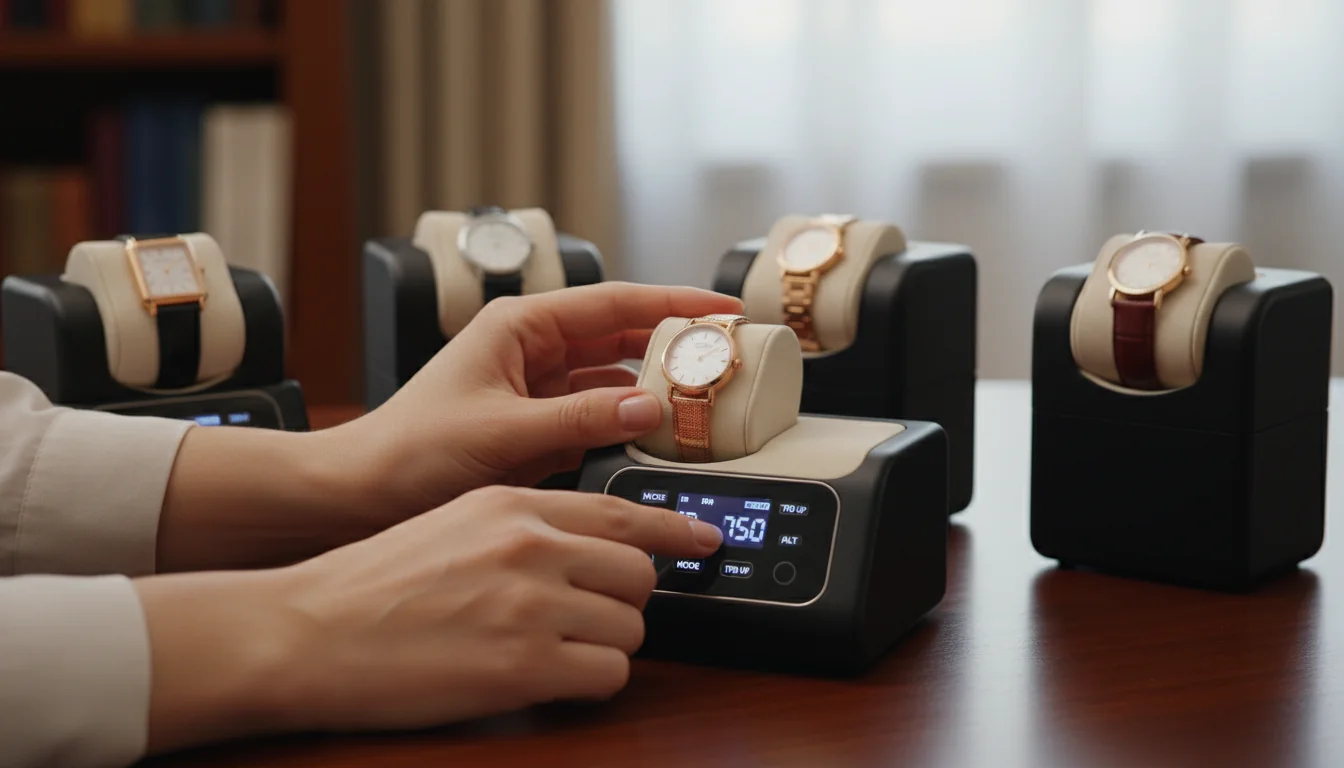
Small women’s automatic watches benefit from gentle, precise programming. Set turns per day (TPD) to maintain power without stressing the mainspring or date mechanism.
- Target a quiet motor with low vibration; under-bedroom noise is key for night use.
- Choose adjustable TPD: 650–950 covers most three-hand or date calibres.
- Alternate clockwise/counterclockwise or bi-directional rotation to emulate wear.
- Prefer rest intervals; continuous spinning is unnecessary for daily running.
| Movement profile | Typical TPD / Direction |
|---|---|
| Three-hand + date | 650–800 TPD, bi-directional or alternated |
| No-date minimal | 600–700 TPD, any direction tolerated |
| Day/date or small complications | 750–950 TPD, alternating preferred |
Avoid overwinding. If your watches run daily, schedule off-cycles. Also, keep any winder away from strong magnets that can disturb accuracy.
Most winders offer four rotation programs—two single-direction, one alternating, and a mixed cycle with long rests. For petite cases, the alternating mode plus rests preserves amplitude and calendar integrity.
Power and placement: at home
Consider where your watches will live. Bedroom placement demands silence; entry console needs stable footing; closet shelves require door clearance and cable routing.
- USB-C or DC inputs simplify power on tight shelves; battery backup supports safes.
- Check lid and bezel clearance; petite watches shouldn’t touch the acrylic window.
- Prefer LED lighting with an independent switch for night use.
- Rubber feet and balanced weight prevent resonance on wooden furniture.
A compact cube’s Depth 15 cm often fits narrow closets, but the DC plug adds a few millimeters. Measure cable bends before committing.
If you mainly wear one watch, keep the winder on a dresser for easy access. For collections, a stackable or multi-slot case consolidates power and reduces visual clutter in your Art of living space.
Materials and storage: daily care
A winder is also a display box. For small women’s automatic watches, interior touch matters: microfiber linings protect polished lugs and jewelry compartments keep chains away from cases.
- Look for soft linings and flexible pillows for narrow straps.
- Choose wood veneer, carbon-look, or matte finishes to match décor.
- Separate jewelry storage reduces scratches and tangle risks.
- Tempered glass lids resist micro-scratches and dust.
For gift ideas in 2026, pair a single winder with a small tray for rings. It keeps watches and accessories ready by the door.
Many jewelers recommend separating leather and metal: keep your watch on the cuff and bracelets in the drawer. It prevents clasp impressions on supple straps.
Five picks: compact to modular
Below are five winder formats that work particularly well with small women’s automatic watches. Each option respects petite case sizes, gentle winding, and quiet living spaces.
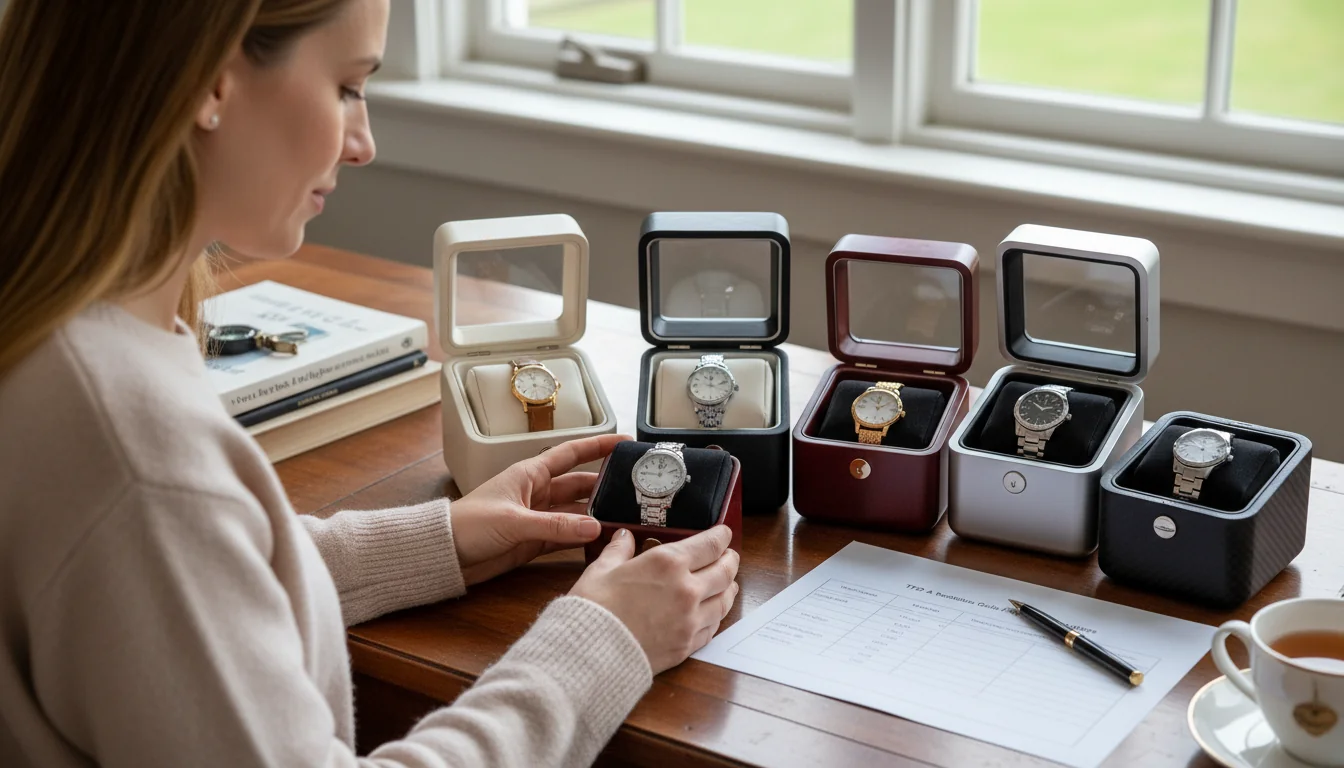
- Compact single cube: Narrow pillow, adjustable TPD (650–900), alternating rotation, independent LED switch. Ideal for one treasured piece kept on the nightstand.
- Slim dual winder: Two independent motors with separate programs; great for a daily and a dress watch. Thin profile fits shallow shelves and small safes.
- Travel-ready single case: USB power and battery backup, padded lid, and soft cuff. Quiet motor suits hotel rooms; protective shell doubles as a storage box.
- Modular brick unit: Stackable cubes with pass-through power. Start with one, expand later. Keeps a growing collection tidy without re-cabling.
- Four-cuff cabinet: Low-resonance chassis, touch controls, and a shallow drawer for straps. Works for partners sharing space or a curated set of small automatics.
Check slot diameter and lid clearance. Petite cases should not contact the window during rotation, even on the thickest pillows.
If you love the display aspect, pick LED lighting with a warm tone. It flatters dials and keeps watches readable without harsh reflections.
How to set up your winder (2026)
Starting with a single petite piece? Consider a compact single-slot option to learn your watch’s ideal TPD and direction before scaling.
- Seat the watch snugly on the flexible pillow; clasp at your normal hole.
- Begin with 650 TPD, bi-directional, and long pauses.
- Place the winder on a stable surface; test noise at 30 cm.
- After 24 hours, check timekeeping and power reserve behavior.
- Adjust TPD by ±100 if the reserve drops or time drifts.
Crown-up orientation often reduces strap stress on small women’s watches; try it if the clasp touches the lid.
Managing two petite automatics? A balanced unit with independent programs helps. Explore a two-watch format for pairing his-and-hers without compromising settings.
Why use a winder for women’s automatics?
It keeps watches running when you rotate outfits. That preserves date accuracy, reduces frequent manual setting, and keeps lubricants moving—useful for small calibers worn a few days per week.
How does a winder compare to manual winding?
Manual winding works, but regular crown use adds wear and risks mis-setting dates. A gentle, programmable unit like a dual-winder with mixed materials can keep two watches ready with fewer handling cycles.
What TPD is best for petite movements?
650–800 TPD is a sensible start. If the reserve still decreases, step up in 100-TPD increments. If you notice gaining time, reduce TPD or lengthen rest periods.
Will a thick pillow stretch small straps?
It can, which is why flexible, narrow cuffs matter for women’s watches. Consider a minimalist dual design in dark wood that includes compressible inserts for slender bands.
Can winders damage delicate watches?
With appropriate TPD, soft starts, and secure fit, damage is unlikely. Avoid magnetic closures near the rotor and do not use a winder if a movement needs service.
Where should I place a winder at home?
A stable, low-vibration shelf away from sunlight and speakers. Keep cables neat, ensure airflow at the rear, and use silica gel if the case is sealed.
For Small Women’s Automatic Watches, the right winder blends slim-fit pillows, quiet motors, and cautious rotation so your timepieces stay ready without stress.
If your collection is growing, consider a four-spot unit for small collections with independent programs and soft lighting.
- Check pillow compression and lid clearance before use.
- Start at 650–800 TPD with long rest cycles.
- Target ≤30 dB and switchable LEDs for bedroom placement.
Choose thoughtfully, and your watches will look pristine and run on time—every day in 2026.
0 comments