


Single Watch Winder

If an automatic watch rests for a couple of days, it can stop and lose calendar settings. Resetting a moonphase or annual date takes time and precision. A single watch winder solves this by maintaining calibrated TPD and rotation direction while your timepiece sits protected and ready. Unlike static storage, a dedicated unit provides measured motion that mimics the wrist and preserves accuracy.
This page focuses solely on the winder itself—its motion profiles, quiet motor design, compact form, power options, and display features—so you can choose a module that keeps an automatic movement within spec without fuss. Browse below for concise comparisons, practical tips, and answers that cut to what matters in a single winding module.
A winder is not just a spinning box; it is a motion tool that follows a movement’s requirements. The core variables are turns per day (TPD) and direction. Quality modules count each rotation electronically and pause between cycles to avoid overwinding, then park the dial neatly at 12 o’clock for display. The result: a timepiece that remains wound within its designed power-reserve window.
| Criterion | Guidance for a single module |
|---|---|
| Typical TPD | 620–1,200 for many three-hand calibers; 900–1,300 for date and day-date; up to 1,600+ for certain high-torque movements. |
| Direction | If unknown, start bidirectional; refine after checking the manufacturer’s parameters. |
| Park position | 12 o’clock improves visual balance and reduces rotor shadowing in display cases. |
Most automatic watches run down in two to three days if unworn. A single watch winder maintains motion in short, measured bursts—avoiding constant rotation—so the mainspring rests between cycles while complications stay synchronized.
"Unlike passive boxes, a dedicated module delivers specific TPD and direction, which is what protects accuracy rather than merely storing the watch."
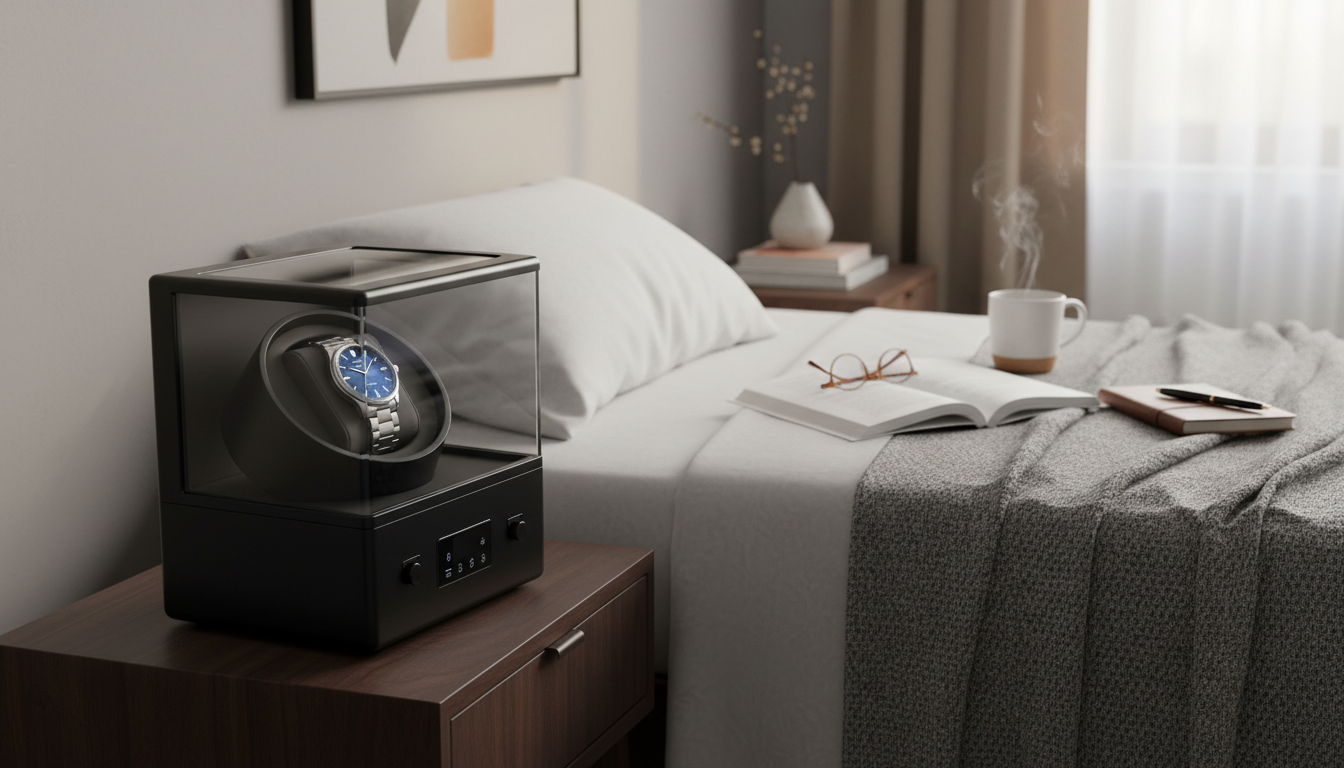
Noise is the difference between a winder you use daily and one you disconnect. Look for ultra-quiet module design with vibration damping, rubber isolation, and well-tuned bearings. A “night mode” that suspends cycles for about 12 hours keeps the bedroom silent while maintaining the daily total of rotations.
| Noise factor | What to expect from a quiet single unit |
|---|---|
| Motor hum | Barely audible at arm’s length; consistent frequency without rattles. |
| Case resonance | Sturdy casework and soft feet prevent vibration transfer to nightstands. |
| Cycle timing | Intervals spaced through daytime; optional sleep window at night. |
Place a winder on a stable, non-hollow surface. Even a quiet module can sound louder on thin wood shelves where resonance amplifies low-frequency hum.
If comparing across sizes and finishes, consider the broader watch-winder lineup for context—see the dedicated range of single and multi-module winders to contrast control schemes, materials, and damping approaches.
A single module earns space on a desk or shelf by doing more than turning rotors. It should shield from dust, present the dial upright, and fit elegantly in home organizers. Popular enclosures include leather-clad cubes, carbon-textured housings, and piano-lacquer wood with tempered glass or acrylic doors. Some add key locks and subtle LED accents for low-light viewing.
| Display feature | Benefit for a single winder |
|---|---|
| 12 o’clock parking | Keeps indices upright; aligns with glass door for a gallery look. |
| LED accent light | Soft illumination without heat; useful in cabinets or low ambient light. |
| Lockable door | Discourages tampering; handy in shared spaces or open shelving. |
Prefer a tactile, stitched exterior? Explore leather-clad options within this category via the curated selection of single winders in leather finishes for a softer touch and warm visual texture.
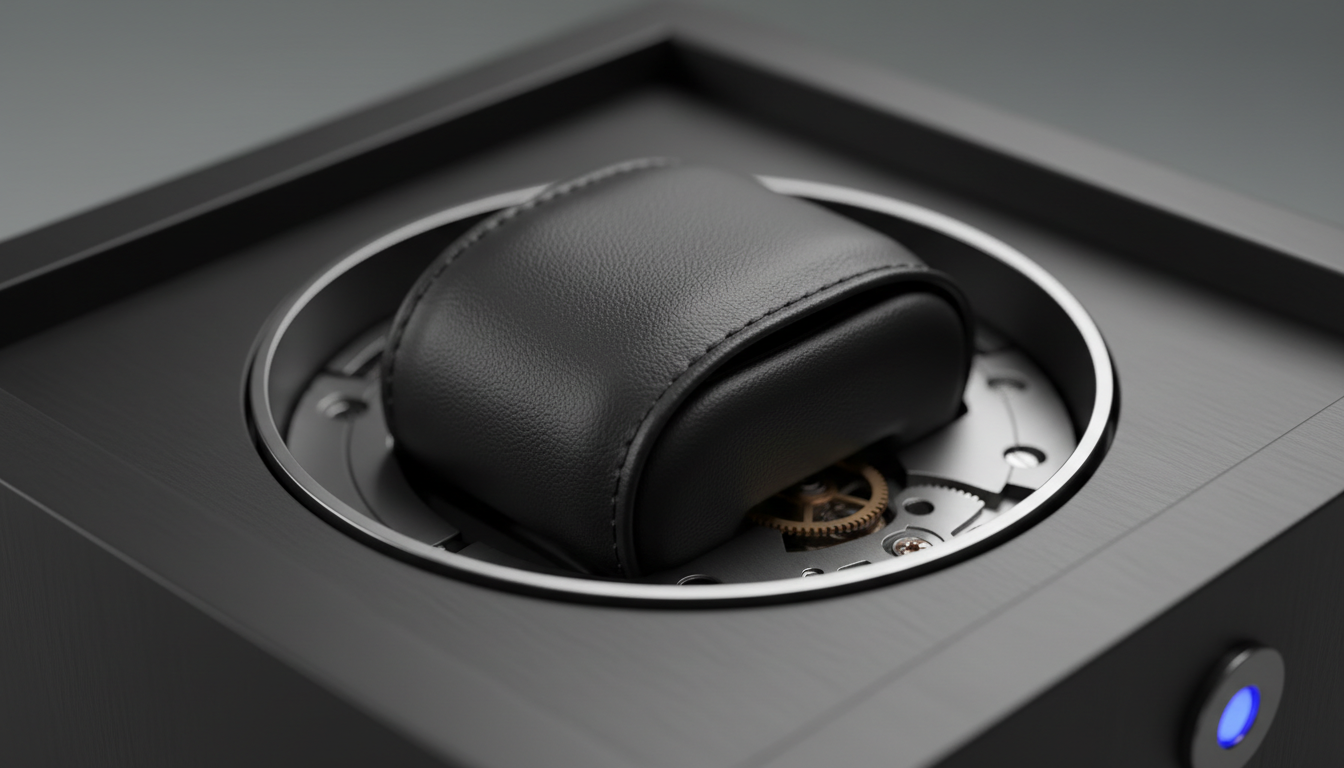
Power flexibility determines where a single watch winder can live. Many units include an AC adapter (100–240 V, 50–60 Hz) for desks and shelves, plus battery operation for safes or travel. Increasingly, USB‑C brings convenient power in offices with limited outlets. Look for memory that retains TPD settings after unplugging.
| Power mode | Use case for a single unit |
|---|---|
| AC adapter | Permanent home on a shelf; constant voltage; minimal battery waste. |
| Batteries | Quiet safes or cabinets without outlets; useful for travel or seasonal use. |
| USB‑C | Desktops with shared power strips or monitor hubs; easy cable routing. |
If a technical, modern aesthetic appeals, consider carbon-fiber finishes that echo instrument panels while keeping weight low and rigidity high.
When testing a new module, start with 650–800 TPD in bidirectional mode. If the power reserve still climbs too slowly, step up in 100–150 TPD increments until the reserve stabilizes between daily wears.

Selecting a single-module winder is about matching motion, fit, and placement. Use these criteria to zero in quickly.
| Type | Best for |
|---|---|
| Compact cube | Stackable footprint, small desks, straightforward controls, battery ready. |
| Display unit with cover | Dust-shielded presentation, 12 o’clock park, optional LED accent in cabinets. |
| Travel-friendly module | Battery-driven reliability in hotel safes; lightweight and vibration-damped. |
For a warmer hue that pairs well with walnut furniture, consider the single-slot option in a deep ember tone like a Braise-finished unit with measured TPD control and a dust cover.
Seeking a light, oak-inspired aesthetic? An oak‑beige single module offers quiet operation, a 12 o’clock park, and a secure cuff sized for everyday straps.
Static cases protect from dust but don’t maintain motion. A single winder sustains a movement’s power reserve with bidirectional modes and tailored TPD, so calendar and GMT functions stay set. It’s about readiness: pick up, strap on, and go without resetting or manual winding.
Multi units save space for several timepieces, but a single device isolates vibration, reduces motor hours, and lets you tune precise TPD to one caliber. For those rotating daily wear, a focused module like a matte‑black single is efficient and quiet.
Key benefits include measured motion to preserve accuracy, a 12 o’clock stop for display, dust shielding via a cover, and compact footprints that fit shelves and safes. AC, battery, and USB‑C options extend placement flexibility in home organizers and storage cabinets.
Yes—particularly for perpetual calendars, moonphases, or dual‑time functions. Maintain motion with the correct direction and TPD to avoid lengthy resets. If case size is large, ensure the cuff accepts the lug span and thickness, then use a night pause to keep things quiet.
Check the caliber’s guidance. If unknown, begin at 650–800 TPD bidirectional. Observe after 48 hours: if the power reserve stalls, increase incrementally. Many users fine‑tune within a week to a steady state that matches personal wear patterns.
Leather wraps and lacquered wood read warm and classic; carbon textures skew modern. For a darker accent with a clean dial presentation, explore a deep‑tone single module featuring a protective cover and park positioning.
A single watch winder keeps one automatic on point—measured motion, quiet motor behavior, dust protection, and a compact, stackable build. Dial in TPD and direction once, then let the module maintain readiness day after day. For a streamlined setup tailored to daily wear, consider a single-slot tuned for daily rotation and enjoy pick‑up‑and‑go convenience.


